Artificial Grass in Newcastle: Is It Right for Your Garden?
There is a version of this decision that gets made badly, usually in August, after a summer of mowing a lawn that still looks patchy. Artificial grass suits some gardens brilliantly and suits others poorly, and the difference has less to do with the turf than with what sits underneath it.
If you are weighing up artificial grass in Newcastle, here is a straight account of where it works, where it does not, and what separates a good installation from one you will regret.
Why Local Gardens Go Artificial
Across the south of England, artificial grass is often sold as a drought answer. That argument barely applies here. Northumberland holds Kielder Water, which stores roughly 200 billion litres and is the largest artificial reservoir in the UK by capacity, and it is a large part of why hosepipe bans are far rarer in the North East than elsewhere in the country.
So the reasons homeowners in Newcastle switch tend to be different, and more practical:
- Mud: shaded, clay-heavy back gardens that never recover between October and April.
- Wear: a trampoline, a goal mouth or a dog run that grass cannot regrow under.
- Shade: narrow gardens boxed in by terraces and fences where sun barely reaches the ground.
- Time: no mowing, no edging, no feeding, no scarifying.
- Consistency: a usable surface in November, not just in July.
Where It Works, and Where It Does Not
Being honest about this saves money.
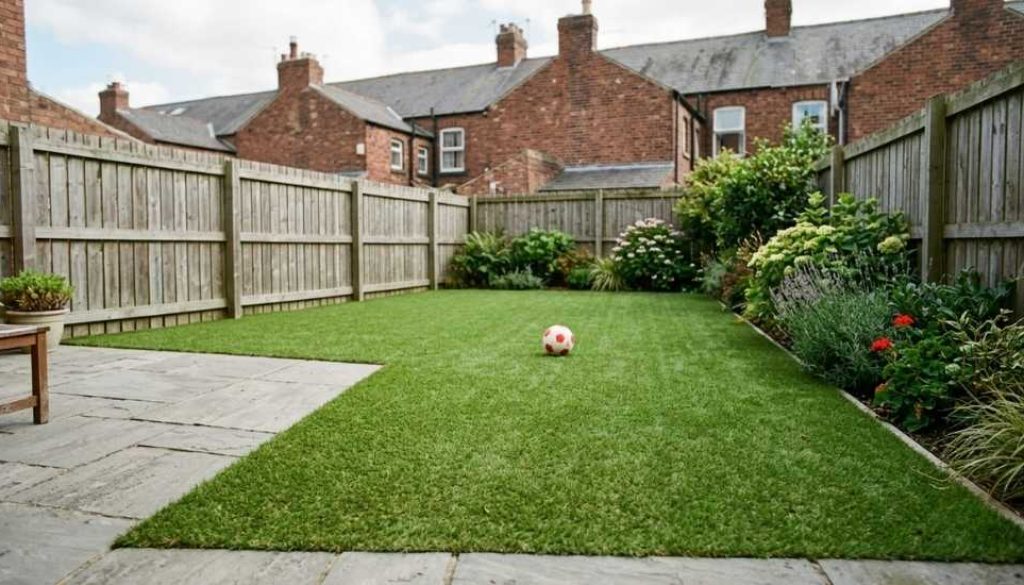
Artificial grass works well on small to medium gardens, shaded plots, family gardens with heavy foot traffic, roof terraces and balconies, awkward slopes, and around patios where a neat green edge finishes the space.
It works less well in a few situations:
- Full-sun gardens: synthetic fibres absorb heat and can get uncomfortably warm underfoot on the hottest afternoons.
- Large open plots: costs climb quickly, and a big expanse can look flat and uniform.
- Wildlife gardens: it supports no insects and no soil life, so leave planted borders and beds around it.
- Very wet ground: it drains well through the backing, though ground that already floods needs the drainage solved first.
What Proper Installation Actually Involves
This is where most complaints originate. Turf laid straight onto old lawn or bare soil will sink, ripple and hold water within a couple of seasons.
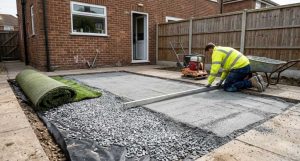
A correct build follows a set sequence:
- Strip the existing turf and topsoil to a depth of around 75mm to 100mm.
- Lay a weed membrane over the exposed subgrade.
- Spread and compact an aggregate sub-base in layers, checking levels as you go.
- Screed a granite dust or sharp sand layer to a smooth, even finish.
- Roll out the turf, leave it to settle and relax, then trim to the edges.
- Join seams with joining tape and adhesive, keeping every fibre running the same direction.
- Secure the perimeter with pins or timber edging, then brush in kiln-dried sand and power brush the pile upright.
Ask any installer to describe those steps before you sign anything. The answer tells you most of what you need to know.
Drainage Comes First
Good turf has a perforated backing that lets water pass straight through, so the surface itself rarely causes problems. The ground beneath is another matter.
Clay subsoil, compacted ground and gardens that already sit wet all need addressing before the turf arrives. Depending on the plot, that can mean a deeper aggregate layer, a land drain, a soakaway, or falls set to direct water to a border. Covering a drainage problem with a green surface hides it for one winter and then returns it, usually with a smell attached in gardens where dogs are using it.
Choosing the Turf Itself
Samples vary far more than the photographs suggest. Look at four things:
- Pile height: roughly 30mm to 40mm suits most family gardens. Longer piles flatten under regular use.
- Density: the number of stitches per square metre. Denser turf costs more, springs back better and lasts longer.
- Colour blend: natural lawns are not one shade. Turf with mixed greens, a brown thatch layer and varied fibre shapes reads far better than a single flat green.
- Backing and warranty: fully permeable backing, UV stability and a written guarantee, typically eight to fifteen years.
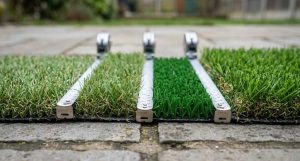
Look at samples outdoors and at a low angle, because a piece held flat in the hand looks nothing like a whole garden seen from a kitchen window.
What It Still Needs From You
Low maintenance does not mean no maintenance.
- Brush the pile every month or two in high-traffic areas.
- Clear leaves in autumn before they break down into the sand.
- Rinse pet areas regularly, and use an enzyme cleaner where needed.
- Top up jointing sand every few years.
- Keep barbecues, fire pits and hot ash well clear, as synthetic fibres melt.
Cost, Lifespan and Value
Artificial grass costs considerably more than turf on day one and less over its life. Most quality installations run ten to twenty years depending on traffic and turf grade.
The variables that move a quote are the same ones that move any groundwork job: area, access, excavation depth, disposal of spoil, drainage work, edging, and the turf specification. Cheap quotes usually cut the base, which is the part that determines whether the surface is still flat in five years.
Ask for a breakdown that itemises the excavation and sub-base separately from the turf.
Grass, Paving or Both?
Plenty of gardens do not need to choose. The strongest layouts usually mix the two, giving each surface the job it does best.
- Turf near the house, paving further out rarely works. Put the seating and dining area on paving close to the back door, where furniture stays level and chairs do not sink.
- Grass in the middle gives children and pets a soft, open space without mud.
- Paths in stone or block carry the daily traffic between shed, gate and bins, so nothing wears a track across the turf.
- Borders around both keep planting, wildlife and colour in the garden.
A combined scheme also spreads the cost sensibly, since paving handles the areas that take the heaviest use and turf covers the larger open ground more cheaply.
Getting It Done Before Autumn
Late summer is a sensible window. The ground is dry, excavation is cleaner, and the finished garden is ready before the wet months arrive.
- Book a site visit and free written estimate.
- Agree the drainage approach and base build-up.
- Choose the turf from outdoor samples.
- Combine it with fencing, paving or landscaping in one visit rather than several.
M&C Paving Northeast installs artificial grass, block paving and full garden schemes across Newcastle upon Tyne, Blyth, Northumberland, Tynemouth and North Shields, using an in-house team with more than 25 years of experience. Recent projects are in our gallery.
FAQs
For all your paving and landscaping services…
Call us today – 0191 743 2048