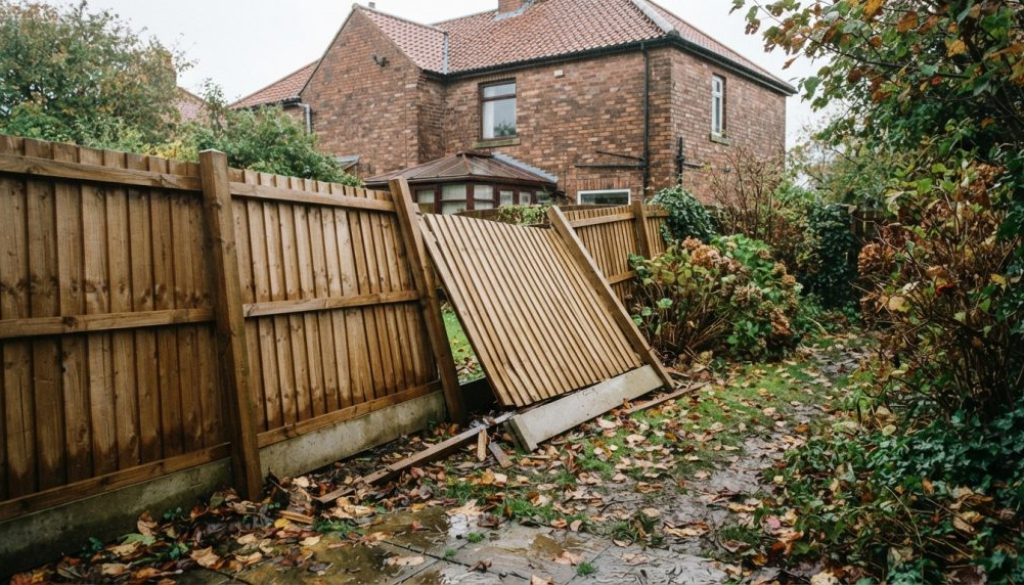
Leaning Fence After a Storm? Repair or Replace Before Winter
A fence rarely falls on a calm day. It goes in the first proper gale of autumn, usually overnight, and usually after leaning quietly for months. By October, plenty of North East gardens have a section that rocks when you push it, a panel that rattles in its slot, or a post that has started tilting into the next door’s garden.
A leaning fence is not always a lost fence. Most fence repair in Northumberland and across Tyneside comes down to one question: is the problem in a single post, or is the whole run tired? Answer that before the winter storms arrive and you can often fix the fault for a fraction of the cost of starting again.
Why Fences Fail at the Base
Look at a blown-down fence and the panels are often still in one piece. What gave way was the post, almost always at the point where it meets the soil.
That strip of timber at ground level sits in the worst possible conditions. Below it, the soil holds water. Above it, air keeps getting in. Wood-decay fungi need both moisture and oxygen, and the soil line gives them a steady supply of each.
This is why the timber treatment standard places in-ground posts in Use Class 4, the same hazard category as wood sitting permanently in fresh water. On paper, a garden fence post is treated as if it lives on a riverbank.
Wind then finishes the job. A 1.8 metre panel works like a long lever, and every gust pushes its full height against that one weakened band at the base. A post can look sound at eye level and be soft right through where it matters.
How to Diagnose a Leaning Fence
Before deciding anything, spend ten minutes walking the length of the fence. A few simple checks tell you far more than a glance from the kitchen window.
The Push Test
Stand at each post and push firmly at chest height.
- Solid with no movement: the post is fine.
- Slight give but springs back: keep an eye on it through winter.
- Rocks or creaks at the base: the post has lost its grip in the ground or its timber has failed.
Check Below the Soil Line

Scrape back a few centimetres of soil around any suspect post and press a screwdriver into the wood. Sound timber resists. Rotten timber is soft, damp and breaks away in fibres. If the screwdriver sinks in easily on more than one face, the post is beyond saving.
For concrete posts, look for cracks near the ground, exposed reinforcing wire or a loose collar at the base.
Look at the Panels and Rails
Panels that have slipped in their slots, split horizontal rails or boards pulling away from their fixings all point to a fence that has been flexing for some time. Pay attention to the bottom edge too. Timber sitting directly on wet soil, or buried under a raised border, rots from the bottom up.
When a Repair Will Hold
A repair makes sense when the damage is limited and the rest of the fence still has plenty of life in it. Typical examples include:
- One or two failed posts in an otherwise sound run. The old post can be dug out and replaced, and the existing panels refitted.
- A timber post that is rotten only at the base. A concrete repair spur can be set in the ground beside it and bolted to the sound timber above, taking the load off the rotten section.
- Panels that have lifted or slipped. If the posts are firm, refitting and securing the panels is often enough.
- Isolated storm damage, such as a single panel struck by a falling branch.
The limit is how much good fence remains. Patching three posts on a fence where the panels are already grey, brittle and splitting tends to buy one winter, not five.
When Replacing the Fence Makes More Sense
Sometimes a repair just means paying twice for the same fence. Replacement usually offers better value when:
- Several posts along the run fail the push test.
- The panels are brittle, split or soft along their bottom edges.
- The fence has already been patched more than once.
- Posts were set in concrete collars that hold water against the timber.
- You want a different height, style or level of privacy anyway.
If the fence would need replacing within a couple of years regardless, autumn damage is a sensible prompt to do the job now rather than spend money on a run that is close to the end.
The comparison below sets out the three most common routes.
|
Option |
Best Suited To |
Rot Risk |
Wind Performance |
Appearance |
|
Replacement timber post |
Single failed posts in a sound fence |
Returns over time at ground level |
Good when set firmly |
Matches the existing timber |
|
Concrete repair spur |
Posts rotten only at the base |
Takes the rotten section out of the load path |
Good in the short to medium term |
Concrete visible beside the post |
|
Concrete posts with gravel boards |
Full replacement or long runs |
Low, as no timber touches the soil |
Strong, with panels held in slots |
Neat and practical |
Choosing a Fence That Copes With North East Wind
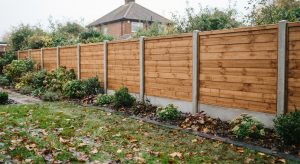
Coastal towns like Blyth and open plots across rural Northumberland take far more wind than a sheltered city garden. If you are replacing a fence, a handful of choices make a real difference to how it handles the weather.
- Concrete posts. They do not rot, and slotted versions let panels slide in from above, which makes swapping a damaged panel quick and simple later on.
- Gravel boards. A concrete or treated board along the bottom keeps the panel clear of the soil, so the timber stays drier for longer.
- Panel style. Solid panels block the most wind and take the most load. Slatted or hit-and-miss designs let some air pass through while still giving good privacy.
- Post depth and setting. A post is only as steady as the ground holding it. Correct depth and a firm base matter more than the thickness of the timber.
- Drainage along the fence line. Soil heaped against the base, or a border that stays waterlogged, shortens the life of any fence.
Boundary walls tend to struggle in the same wet, windy months, so if brickwork shares the boundary, it makes sense to check the warning signs in garden walls before winter at the same time. Settling soil can also tilt posts long before rot sets in, a problem explained in our guide to how ground movement shifts garden structures.
If privacy was the main reason for the original fence, our earlier article on choosing fence panels for garden privacy covers heights and styles in more detail.
Who Is Responsible for the Fence?
Before any work starts on a boundary fence, it helps to know whose it is. There is no fixed rule that you own the left-hand fence or the one with the posts facing your garden.
Start with your title deeds and the Land Registry title plan. A “T” mark on your side of a boundary line usually means that boundary is your responsibility. Two T marks facing each other, forming an “H”, suggest the responsibility is shared. Many plans carry no marks at all, and title plans normally show general boundary positions rather than exact lines.
Planning rules matter if you are changing the fence rather than replacing it like for like. In England, a new fence up to 2 metres high generally does not need planning permission, but the limit drops to 1 metre next to a road used by vehicles. Listed buildings and properties with restricted permitted development rights carry extra conditions, so check with your council if either applies.
A short conversation with your neighbour before work begins saves a lot of awkwardness afterwards, particularly where the fence is shared.
Getting Your Fence Sorted Before the Worst of Winter
A leaning fence is a warning, not a verdict. Check each post, work out whether the damage is isolated or spread along the run, and decide based on how much sound fence remains. Fixing one post in October costs far less than clearing up a collapsed run in January, along with whatever it landed on.
Our team of local fencing contractors handles everything from single post replacements to full runs with concrete posts and gravel boards. We also carry out fence installation across Northumberland, along with matching brick piers and boundary walls where a boundary needs more than timber.
If your fence has started to lean, arrange a fence assessment and we will tell you honestly whether a repair will hold or whether it is time to replace it.
FAQs
For all your paving and landscaping services…
Call us today – 0191 743 2048