Garden Steps and Darker Evenings: How to Make Them Safer
The clocks go back on Sunday 25 October. From that week on, most people coming home from work will reach their back door, bins or shed in the dark, and the garden steps that felt fine all summer suddenly become the riskiest part of the walk.
Safe garden steps are not about expensive materials. They come down to even heights, deep enough treads, edges you can see and surfaces that grip when wet. Most of the problems are easy to spot in daylight, which makes October the right month to look.
Why Garden Steps Catch People Out After Dark
Climbing steps is mostly automatic. After the first two or three, your legs settle into a rhythm and stop checking each one. That works perfectly until one step is a little taller, a little shorter or a little narrower than the rest.
In daylight, your eyes quietly correct the mistake before your foot lands. In the dark, that safety net disappears. A difference of a couple of centimetres is enough to catch a toe on the way up or send a heel off the edge on the way down.
Garden steps are also far more likely to be uneven than indoor stairs. They are often built from leftover slabs, adjusted by eye, and then shifted by years of frost, roots and settling soil.
The 350-Year-Old Rule Behind a Comfortable Step
In 1675, the French architect François Blondel published a simple observation: a comfortable step matches the length of a normal walking stride. He expressed it as a formula that builders still use today. Twice the height of the step, plus the depth of the tread, should roughly equal one pace.
The same relationship appears in modern guidance for stairs in buildings. Approved Document K says twice the rise plus the going (2R + G) should fall between 550mm and 700mm.
Garden steps are not covered by those regulations, but the rule is just as useful outdoors. A few worked examples:
- 150mm rise with a 300mm tread: 2 × 150 + 300 = 600mm. Comfortable.
- 200mm rise with a 200mm tread: 2 × 200 + 200 = 600mm. Within range, but steep and narrow for a wet garden.
- 100mm rise with a 600mm tread: 2 × 100 + 600 = 800mm. Too long for one stride, so people take an awkward half-step.
Outdoors, shallower rises and deeper treads usually feel better, especially on slopes where people carry shopping, bins or garden tools.
Common Faults Worth Checking This Month
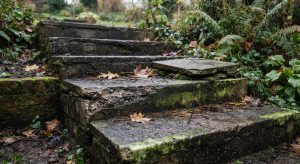
Walk your steps slowly in daylight and look for the faults below. Most garden step trips trace back to one of them.
|
Fault |
Why It Causes Trips |
Practical Fix |
|
Uneven step heights |
Breaks the rhythm your legs expect |
Rebuild so every rise matches |
|
Shallow treads |
Heel hangs off the edge going down |
Extend treads or rebuild the flight |
|
Broken or rounded edges |
The edge is hard to judge |
Replace the tread or fit a new nosing |
|
Rocking or loose slabs |
Moves unexpectedly underfoot |
Lift and relay on a firm bed |
|
Algae and moss |
Loses grip once wet |
Clean and improve drainage |
|
No visual contrast |
Edges disappear in low light |
Contrasting nosings or lighting |
|
Water pooling on treads |
Slippery, and freezes in winter |
Relay with a slight fall to the front |
Uneven Rises
Measure each step from the top of one tread to the top of the next. Small differences matter more than people expect. The first and last steps are the usual culprits, because a patio or path level has changed since the steps were built.
Edges You Cannot See
Grey slabs on grey slabs look fine at midday and vanish at dusk. If you cannot pick out each edge clearly from the top of the flight on an overcast afternoon, you will not see them at night either.
Loose or Rocking Treads
Stand on each step and shift your weight. A slab that tilts or clicks has lost its bedding. Left alone, water gets underneath, frost lifts it further, and the step becomes a trip hazard and a repair job at once.
Making Steps Easier to See
Visibility is often the quickest and cheapest improvement. The aim is simple: every edge should be obvious before your foot reaches it.
- Contrasting nosings. A darker or lighter strip along the front of each tread marks the edge clearly. This can be a different stone, a contrasting bullnose slab or a brick edge.
- Low-level lighting. Lights set into the riser or the side wall wash across the treads without shining in your eyes. Bright lights at head height can make things worse by creating glare and deep shadows.
- Lighting at the top and bottom. Most falls happen on the first or last step, so these need the clearest view.
- Trim back plants. Overhanging shrubs hide edges and drip water onto the treads.
Any wiring for outdoor lighting should be carried out by a qualified electrician, ideally planned before steps are rebuilt so cables can run neatly inside the structure.
Handrails: When They Are Worth Adding
A handrail costs little compared with a fall. It makes sense on longer flights, steep slopes, steps without a wall alongside, and anywhere older relatives, young children or visitors regularly walk.
Indoor guidance in Approved Document K places handrails at 900mm to 1000mm above the pitch line, which is a sensible reference for garden steps too. The rail should run the full length of the flight, be easy to grip, and be fixed into something solid rather than a loose coping stone.
Repair or Rebuild Your Garden Steps?
Not every problem needs a new flight. Some fixes are small, while others only work if the steps are built again from the base up.
When Repairs Are Enough
- One or two loose slabs that can be lifted and relaid.
- Algae on otherwise sound treads, which cleaning and better drainage can control. Our guide on why paving turns slippery in autumn covers this in detail.
- Missing contrast, which new nosings or lighting can solve.
When Rebuilding Makes More Sense
- Step heights vary and cannot be corrected by relaying.
- Treads are too shallow to stand on comfortably.
- The steps have moved because the base or retaining structure has failed.
- You are already planning a new patio or path and want the levels to work together.
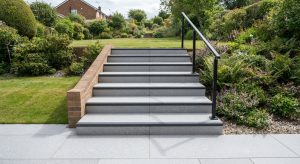
For rebuilt steps, material choice matters. Riven Indian stone step treads offer natural texture and grip. Porcelain needs a textured outdoor finish to perform well when wet. Brick-built garden steps give a crisp, durable riser that suits many North East homes. Whatever the surface, each tread should have a slight fall to the front so rainwater runs off rather than sitting on the step.
Steps also work best when planned as part of the wider garden. Our article on planning practical garden path layouts shows how routes, levels and steps fit together, and our earlier piece on slip and trip risks around the home looks at the same problems at the front of the house.
Safer Steps Before the Clocks Go Back
A safe garden step has an even rise, a tread deep enough for your whole foot, an edge you can see and a surface that sheds water. Check all four in daylight this month, before you are relying on them in the dark every evening.
If your steps need more than a clean, our team handles patio and step installation in the North East, from relaying loose treads to rebuilding a full flight with properly matched rises. We also provide landscaping services for Newcastle gardens where steps form part of a bigger change in levels. Get in touch to arrange a visit and talk through your options.
FAQs
For all your paving and landscaping services…
Call us today – 0191 743 2048