

Fire Pits on Patios: Which Paving Copes and How to Protect It
Longer October evenings and the run-up to Bonfire Night on 5 November send a lot of people looking for a fire pit. It is easy to see the appeal. A small fire stretches the garden season by a few months and gives everyone a reason to sit outside after dark, even when the temperature drops into single figures.
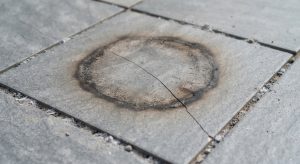
The problem is where it goes. Most people set a fire pit straight onto the patio, and a few weeks later they find a scorched ring, a cracked slab or blackened joints. Putting a fire pit on a patio can work well, but only if the paving suits it and the heat is managed properly.
What Heat Actually Does to Paving
Patio paving is built to handle rain, frost and foot traffic. Concentrated heat from below or beside a fire is a different kind of stress, and it damages paving in three main ways.
Thermal Shock
When one part of a slab heats up quickly while the rest stays cold, the hot area expands faster than the material around it. That strain can crack the slab. Dense, rigid materials are the most vulnerable, which is why porcelain manufacturers’ guidance for fire features calls for insulating material and an air gap between the heat source and the surface.
Trapped Moisture
Natural stone holds water, especially in a North East autumn. Heat that moisture quickly and it turns to steam, which needs room to escape. It is the same reason chestnuts are scored before roasting. When steam cannot get out of a stone, the surface can flake away in layers, known as spalling. Research on fire-damaged buildings identifies spalling as a typical form of heat damage in sandstone, and layered stones are especially prone.
Scorching and Staining
Some damage is cosmetic but permanent. Resin binders can soften or discolour under concentrated heat, and polymeric jointing compounds can melt. Soot and ash also leave dark marks on light stone that are difficult to remove once they soak in.
How Each Paving Material Copes
No standard patio surface is designed to sit directly under a fire. Some cope with radiant heat nearby far better than others, though.
|
Material |
Main Heat Risk |
Suitability Near a Fire Pit |
|
Porcelain |
Cracking from thermal shock |
Fine nearby, but needs a protected base under the fire |
|
Indian sandstone |
Spalling, discolouration and soot staining |
Fine nearby, but avoid direct heat underneath |
|
Concrete block paving |
Discolouration and joint sand damage |
Reasonable, and individual blocks can be replaced |
|
Imprinted concrete |
Surface coating marking, cracking |
Avoid placing a fire directly on it |
|
Resin bound |
Binder softening and scorching |
Keep fire well away or use a separate pad |
|
Gravel or fire brick pad |
Little damage to worry about |
Best choice directly under the fire |
If you are still choosing a patio surface, our guide to comparing sandstone and porcelain slabs covers how each performs day to day, and our article on patio materials for wet and frosty weather looks at year-round durability.
Freestanding Bowls Versus Built-In Fire Pits
There are two broad options: a portable fire bowl or a permanent built-in feature. Each needs different protection, and the right choice depends on how often you plan to use it.
Freestanding Fire Bowls
Short legs do not stop heat reaching the paving. Radiant heat travels downwards as well as outwards, and a bowl sitting low over a slab can damage it within a few uses.
- Choose a bowl with taller legs that holds the fire well above the ground.
- Place it on a dedicated non-combustible pad rather than your best paving.
- Treat thin heat mats with caution, as many are designed to catch embers rather than block sustained heat.
- Never move a hot bowl, and let it cool fully before covering it.
Built-In Fire Pits
A permanent fire pit needs protection on the inside as well as underneath. Supplier guidance for stone fire pit kits states that the fire should never sit directly against the stone. Instead, the pit should be lined with a steel insert that leaves an air gap, fire bricks, or fire-resistant mortar, with a layer of sand and gravel at the base.
Built properly, a stone or brick fire pit surround can become a permanent part of the garden rather than a source of repairs.
Building a Dedicated Fire Pit Pad

The simplest way to protect a patio is to keep the fire off it entirely. A small, purpose-built pad gives the fire its own ground.
- Pick the spot first. Choose the position before any paving goes down, so the pad can be built in rather than added later.
- Separate it from the main patio. A distinct zone of gravel or fire brick takes the heat, and it can be refreshed cheaply if it marks.
- Use non-combustible materials. Fire brick, gravel and heat-rated products cope far better than standard slabs.
- Edge it neatly. A brick or stone border keeps gravel contained and makes the pad look intentional.
- Allow for drainage. Water pooling in the pad will soak into nearby stone, which raises the risk of spalling the next time the fire is lit.
- Leave a margin. Keep the surrounding paving far enough back that radiant heat does not reach it.
On a small patio, the pad can double as a seating circle. Our layout ideas for smaller patios show how to fit a feature like this without crowding the space.
Where to Put a Fire Pit in a North East Garden
Placement matters as much as materials. A well-built pad in the wrong spot still causes problems.
- Fences and sheds. Timber fencing, sheds and summerhouses all burn, so follow the fire pit manufacturer’s minimum clearance distances.
- Overhanging branches. Sparks rise. Keep the fire clear of trees and climbing plants.
- Wind. Coastal gardens in Blyth and along the Northumberland coast see strong gusts. Watch how smoke and sparks would travel in your usual wind direction.
- The house. Avoid sites close to windows, doors or vents.
- Neighbours. Government guidance says there are no laws against garden fires, but smoke that causes a nuisance can lead to council action.
Fire Pit Habits That Protect Your Patio
Good habits extend the life of both the fire pit and the paving around it. Much of the heat damage found on patios comes down to how a fire was used rather than the fire pit itself.
- Burn dry, seasoned wood, which produces less smoke and soot.
- Never use petrol or other accelerants.
- Let ashes cool completely before clearing them.
- Never throw cold water over hot stone, as the sudden temperature change can crack it.
- Brush away soot and ash promptly before rain washes it into the surface.
Planning a Patio Fire Pit Area This Autumn
A fire pit on a patio works best when it is planned rather than placed. Keep direct heat off your main paving, give the fire its own non-combustible base, and position it well away from fences, sheds and trees.
If you are building a new patio, adding a fire area, or repairing heat damage, our team can help. We offer patio installation in the North East, natural Indian stone paving and patio laying in Newcastle, with outdoor living areas planned around how you actually use the garden. Get advice on your patio before the evenings draw in further.
FAQs
For all your paving and landscaping services…
Call us today – 0191 743 2048


