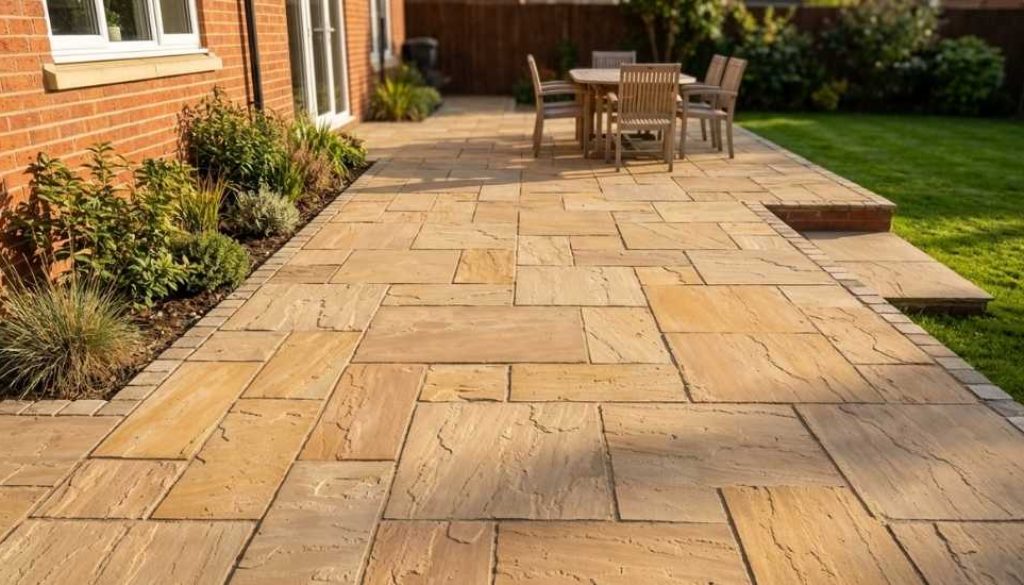
Indian Stone Paving: A Timeless Choice for North East Homes
Walk through Grainger Town in Newcastle and you are looking at sandstone that has held its detail through nearly two centuries of rain, frost and coal smoke. Sandstone has always suited this part of the country, which is a large part of why Indian stone paving in the North East looks so settled against local brick and stone homes rather than imported onto them.
Here is what the material actually offers, how the colours and finishes differ, and what separates a patio that ages well from one that lifts within three winters.
Where the Stone Comes From
Most Indian sandstone sold in Britain is quarried in Rajasthan, which holds roughly 900 of India’s 1,000 million tonnes of sandstone reserves. The rock belongs to the Vindhyan Supergroup, a sedimentary formation stretching across northern India.
It is the same stone tradition behind the Red Fort in Delhi and Agra Fort, both built from Rajasthani sandstone and both still standing after four centuries of monsoons. A material with that record behind it copes comfortably with a Northumberland winter.
Why It Suits Homes Here
Beyond appearance, several practical points work in its favour:
- Frost resistance: dense, low-porosity sandstone handles freeze-thaw cycles well when laid on a correct bed.
- Natural grip: riven surfaces have texture built in, which matters in shaded, damp gardens.
- Colour variation: each slab differs slightly, so the finished area has depth rather than a printed uniformity.
- It ages instead of failing: sandstone weathers into a softer tone rather than peeling or fading.
- Repairability: individual slabs can be lifted and replaced without disturbing the rest.
Colours and What They Suit
Sandstone is sold under trade names that describe the quarry and tone rather than a brand.
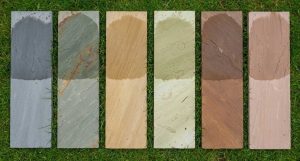
- Kandla Grey: cool, even grey with subtle banding. The most popular choice for modern extensions and grey window frames.
- Raj Green: grey-green with rust and brown veining. Busy, warm and forgiving of leaf litter and garden debris.
- Camel Dust and Rippon Buff: soft golden buff tones that sit beautifully against red brick, which describes most of Tyneside.
- Mint Fossil: pale green-cream, sometimes with visible fossil markings, suited to lighter contemporary schemes.
- Autumn Brown: warm browns and russets that work well with stone-built and rural properties.
- Modak: pink-beige, softer in tone, better in sheltered gardens where it stays cleaner.
A practical tip: buy from one batch where possible, and mix slabs from several packs as you lay. Working straight through pack by pack produces visible blocks of colour.
Riven or Sawn
This is the choice that changes the whole character of a patio.
Riven stone is split along its natural bedding plane, giving an undulating, textured surface with a slightly irregular edge. It looks traditional, provides natural slip resistance, and hides minor wear. Thickness varies between slabs, typically 15mm to 30mm, so the installer adjusts the mortar bed under each one.
Sawn and honed stone is machine-cut to a uniform thickness, usually around 20mm to 22mm, with straight edges and a smoother face. It gives crisp lines, tight joints and a contemporary look, and it is easier to lay level. The trade-off is a smoother surface, so check the slip rating for shaded areas.
Laying It Properly
Almost every failed sandstone patio in the region comes down to the same handful of shortcuts.
- Sub-base: 100mm to 150mm of compacted stone, more where vehicles or soft ground are involved.
- Full mortar bed: a continuous bed of sharp sand and cement, usually 40mm to 50mm deep. Dot-and-dab blobs under the corners cause hollow slabs, cracking and rocking.
- Slurry primer: the back of each slab painted with a cement slurry before bedding. This bonds the stone to the mortar and reduces picture framing, the dark staining that creeps in around slab edges.
- Falls: roughly 1 in 80 away from the house, with finished levels a minimum of 150mm below the damp proof course.
- Joints: 10mm to 15mm, filled fully with mortar or a proprietary jointing compound worked right down. Empty joints let water under the slabs.
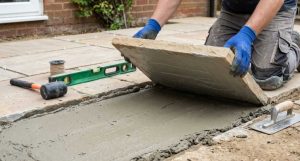
Ask any installer how they bed and prime the slabs. The answer separates people who lay stone regularly from people who occasionally have a go.
Patterns and Sizes
How the slabs are arranged matters as much as the stone itself.
- Patio packs contain mixed slab sizes, usually four, designed to lay in a repeating random rectangular pattern. They suit larger areas and traditional gardens.
- Single size slabs laid in a grid or stretcher bond give a calmer, more modern result and work well in small courtyards.
- Circle features in cut sandstone make a natural centrepiece for seating, with cut-in squaring-off kits to finish the surround.
- Plank formats in long, narrow sawn slabs draw the eye along a garden and suit contemporary schemes.
- Sett borders in a contrasting tone frame the area and tidy the junction with lawn or planting.
Lay the pattern out dry before any mortar is mixed. Seeing it in place beats seeing it on paper, and adjustments cost nothing at that stage.
Cleaning and Upkeep
Sandstone is straightforward, provided you avoid a few common mistakes.
- Sweep and wash with warm water and a mild detergent. A pressure washer on a low setting and a fan nozzle is fine. High pressure held close will erode the surface and blast out jointing.
- Expect efflorescence in the first year, a white bloom of mineral salts drawn to the surface. It weathers off naturally and is not a fault.
- Treat algae in shaded corners with a proper patio cleaner rather than bleach, which can discolour the stone.
- Sealing is optional. A breathable impregnating sealer helps with staining under dining areas and barbecues, though it needs reapplying every few years.
- Avoid rock salt in winter, as it damages the surface and the pointing.
Worth Asking Your Supplier
Sandstone quarrying in Rajasthan has a documented history of poor conditions, including bonded labour, child labour and silicosis from uncontrolled stone dust. The Ethical Trading Initiative has run a programme with UK importers since 2013 to improve working conditions across processing yards and quarries.
Reputable suppliers can tell you where their stone comes from and what standards their supply chain meets. A price that looks remarkably low usually reflects something further down the chain. It is a fair question to ask, and a good merchant will have a straight answer.
Planning Your Project
Late summer suits stone work. The ground is dry, mortar cures steadily, and the patio is finished before autumn.
- Book a site visit and free written estimate.
- Choose your stone and finish from outdoor samples.
- Confirm layout, falls, drainage and edge details.
- Add steps, fencing or landscaping into the same visit.
M&C Paving Northeast has laid Indian stone patios, block paving and gardens across Blyth, Newcastle, Northumberland and the coast for more than 25 years with an in-house team. Recent work is in our gallery.
Call 0191 743 2048 or request a free quote to talk through options at your property.
FAQs
For all your paving and landscaping services…
Call us today – 0191 743 2048