Best Time to Lay a New Driveway in Newcastle
August is one of the calmer, more practical months for driveway work across Tyneside. The ground has had a full summer to dry out, daylight still runs past eight in the evening, and most installers have space in the diary before the autumn rush lands. If you have spent the summer stepping over a cracked surface or eyeing up a lawn you would rather park on, this is a sensible month to move. Here is what late summer offers, what shapes the price, and which surfaces cope with local weather.
Why Late Summer Suits Driveway Work
Timing affects how smoothly a job runs and how well the finished surface performs. Late summer tends to work in the homeowner’s favour on several fronts.
- Drier subsoil: excavation is cleaner, spoil is easier to remove, and compaction plant can do its job properly.
- Longer working days: more daylight means fewer half-finished stages left open overnight.
- Steadier temperatures: tarmac lays and rolls better in warmth, and resin cures without the delays that cold, damp air brings.
- Diary space: August sits between the summer holiday lull and the autumn scramble, so lead times are usually shorter.
- Time before winter: a driveway laid now has weeks to bed in before the first frost tests it.
What Dry Ground Does for the Base
Most driveway failures start below the surface, not on it. Sunken blocks, cracked tarmac and standing water usually trace back to a base that was rushed, laid too shallow, or compacted while the ground was saturated.
Dry conditions let the team dig to full depth, remove soft spots, and build up stone in layers that lock together. Wet ground behaves differently under a compactor: the material moves, water squeezes out, and the surface looks firm while the layer beneath stays loose. A driveway built this way keeps its levels for decades. One built on wet, poorly compacted ground can start moving inside a single winter.

A proper build follows the same order every time:
- Excavate to a depth suited to the traffic the drive will carry, including vans and deliveries.
- Lay a stone sub-base in layers, compacting each one before the next goes down.
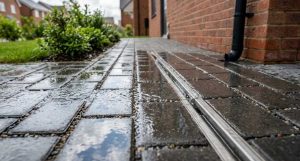
- Set the falls and install drainage so water has somewhere to go.
- Fit edge restraints, then lay the chosen surface.
- Joint, compact, seal where needed, and clean down.
Choosing a Surface That Handles Tyneside Weather
Rain, salt, frost and the occasional heatwave all land on the same square metres. Material choice is really a question of how you want the drive to look and how much upkeep you are willing to do.
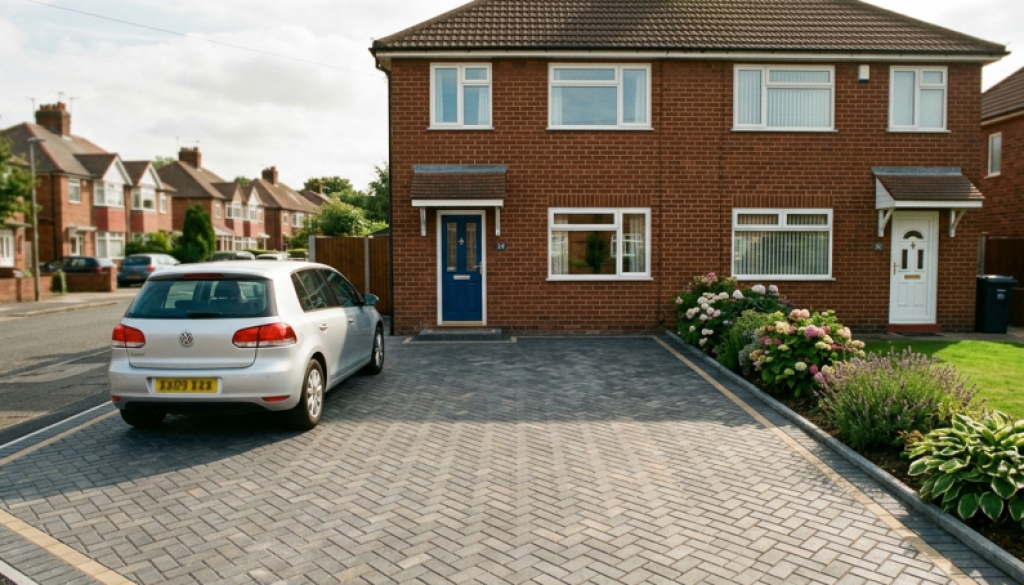
- Block paving: hard-wearing and easy to repair, since a damaged block can be lifted and swapped rather than patched. Permeable versions handle drainage rules neatly.
- Resin bound: smooth, modern and free-draining, with no loose stones to sweep up. It works well with borders, steps and colour blends.
- Tarmac: cost-effective over larger areas and quick to install. Best suited to simple shapes and straightforward layouts.
- Imprinted concrete: a solid single surface with a patterned finish, useful where you want a decorative look without joints.
- Indian stone and porcelain: more common on patios, though both suit paths and borders that tie the front of the house together.
Ask to see samples outdoors rather than in a brochure. Colours read differently under North East light, and a shade that looks warm on a screen can turn flat once it is down and wet. Our gallery shows how each finish looks on real local homes.
Where the Rainwater Goes
Drainage is the part homeowners think about least and councils think about most. Newcastle knows why. On 28 June 2012, a storm Tynesiders still call the Toon Monsoon dropped roughly a month of rain on the city in about two hours. More than 500 homes took water, and almost none of it came from the river. Hard surfaces simply had nowhere to send it.
That history shapes the rules you now have to work within:
- A new or replacement front driveway larger than five square metres needs planning permission if it uses an impermeable surface with no route for water to soak away.
- Permeable block paving, resin bound gravel and porous asphalt keep the job within permitted development.
- Directing run-off to a lawn, border or soakaway inside your boundary also keeps you compliant.
- Water must never be pushed onto the pavement or public road.
- Driving across the footpath requires a dropped kerb approved by the local authority.
Getting this right at the design stage costs nothing. Getting it wrong can mean enforcement action, or a retrospective application when you come to sell.
Repair or Replace: How to Tell
Not every tired driveway needs pulling up. A few sunken blocks or a single cracked bay can often be lifted and reset for a fraction of the cost of a full replacement. The trouble comes when the problem sits underneath.
Replacement is usually the better call when you see:
- Dips or ruts that reappear within months of being fixed.
- Water pooling in the same spot after every shower.
- Weeds pushing through across the whole surface rather than one or two joints.
- Blocks rocking underfoot, which points to a base that has lost its grip.
- Edges spreading outwards because the restraints have failed.
A quick site visit settles it. An honest installer will tell you when a repair is enough, and will show you what they found once the surface is lifted.
What Moves the Price
There is no single figure for a new driveway in Newcastle, because two drives of the same size can differ widely in price. These are the factors that shift a quote most:
- Size and shape: curves, steps and awkward corners take longer than a plain rectangle.
- Excavation depth: heavier use means deeper dig and more stone.
- Ground conditions: clay, made ground or old concrete underneath all add labour and disposal costs.
- Surface choice: resin and porcelain sit at the higher end, tarmac at the lower.
- Drainage work: channel drains, soakaways and re-grading are separate line items.
- Access: narrow lanes and restricted parking slow down deliveries and muck-away.
- Extras: kerbs, edging, lighting, fencing and turfing are worth pricing at the same time rather than later.
Ask for a written breakdown rather than a single lump sum. It tells you what has been allowed for underground, which is where corners tend to get cut.
Booking Before the Autumn Rush
Quotes in September and October fill up fast, and weather becomes less predictable. A short run-up now avoids that squeeze.
- Book a site visit and get a free written estimate.
- Confirm your surface, drainage plan and any permissions needed.
- Apply for a dropped kerb early if access is changing, as council approval takes time.
- Agree a start date, duration and what happens to your parking while work is underway.
M&C Paving Northeast has been building driveways, patios and landscaping across Blyth, Newcastle upon Tyne, Northumberland, Tynemouth and North Shields for more than 25 years, using an in-house team rather than subcontractors. Every quote is free, and finance options are available.
Call 0191 743 2048 or get in touch here to book your site visit while August dates are still open.
FAQs
For all your paving and landscaping services…
Call us today – 0191 743 2048