Why July Is a Good Time to Check Driveway Drainage
July often brings a useful mix of dry spells and sudden showers. That combination makes it easier to see how water behaves across a driveway without waiting for autumn storms or winter frost.
A quick drainage check can reveal puddles, blocked channels, weak falls, and water collecting near the house. Problems with driveway drainage North East homeowners notice in summer are often easier to address before cracks, stains, and surface movement spread.
Watch the Driveway During a Summer Shower
The best time to inspect drainage is while rain is falling or shortly afterwards. Stand somewhere safe and watch where the water travels.
A well-planned driveway should guide water away from the house, garage, walls, and neighbouring properties. Water should move steadily towards a suitable drain, channel, permeable area, or approved outlet.
Look for areas where water slows, changes direction, or collects. Even a shallow puddle can show that the surface level has dropped or the original fall no longer works correctly.
Take photographs while the problem is visible. They can help a contractor understand the pattern after the driveway has dried.
Check How Long Puddles Remain
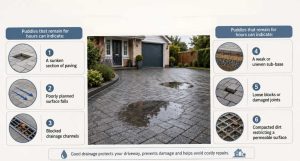
Small amounts of surface water may appear during heavy rain, but they should not sit for long once the shower ends.
Puddles that remain for hours can indicate:
- A sunken section of paving
- Poorly planned surface falls
- Blocked drainage channels
- A weak or uneven sub-base
- Loose blocks or damaged joints
- Compacted dirt restricting a permeable surface
Mark the edges of the puddle with chalk once the rain stops. This makes it easier to compare the low area with the surrounding surface.
Repeated standing water can leave dark stains, encourage algae, and make the driveway slippery. In colder months, trapped water may freeze and place additional pressure on joints and cracks.
Inspect Channel Drains and Grates
Channel drains are commonly installed near garage entrances, doors, pavement edges, and other points where water needs to be intercepted.
Lift removable grates carefully and check for leaves, soil, weeds, stones, and silt. A drain can look clear from above while the channel beneath is partly blocked.
Clean debris away by hand and rinse the channel using a moderate amount of water. Watch whether it flows freely towards the outlet.
If water backs up quickly, the outlet or underground connection may need professional attention. Avoid forcing rods or chemicals into a system without knowing where it leads.
Cracked channels, loose grates, and collapsed edges should also be repaired. A rocking grate can become a trip risk or fail under vehicle weight.
Look at the Driveway Fall
The fall is the slight slope that directs water across the driveway. It may be difficult to see with the eye, especially on a large or textured surface.
Rain provides a simple test. Water should move consistently rather than wandering across the surface or settling against a wall.
Common warning signs include:
- Water running back towards the house
- Puddles beside garage doors
- Damp marks along brickwork
- Water collecting at steps
- Flow crossing the pavement unexpectedly
- Run-off entering a neighbour’s garden
A fall can fail when paving sinks, edges move, tree roots disturb the ground, or previous repairs create uneven levels.
Correcting the issue may involve lifting and relaying part of the driveway rather than adding a thin material layer over the top.
Check Water Near the House
Water sitting beside the house deserves prompt attention. Repeated wetting can stain brickwork, soak lower walls, and make entrances slippery.
Inspect the point where the driveway meets the property. The surface should normally direct water away or guide it into a suitable channel.
Look for damp patches, green growth, loose pointing, crumbling edges, or water marks near air bricks and door thresholds. Air bricks should remain clear and should not sit below a raised driveway surface.
A driveway that has been resurfaced several times may gradually become too high. This can reduce the gap below damp-proof courses and cause water to gather where it should drain away.
Examine Block Paving Joints
Block paving relies on stable layers and properly filled joints. Rain can reveal where jointing sand has washed out or where blocks have started to move.
Check for widening gaps, loose blocks, weeds, ants, and dips that hold water. A few displaced blocks may be repairable individually, although widespread movement can point to a deeper base problem.
Avoid simply filling a depression with extra sand or placing new blocks over an unstable section. The cause should be identified before the visible surface is corrected.
Professional driveway drainage North East work often combines level repairs with drainage improvements so the same problem does not return.
Test Permeable Surfaces
Resin-bound and permeable block systems are designed to allow water through the surface when they are installed over the correct base.
Pour a bucket of clean water onto a dry section and observe how quickly it drains. Slow absorption may result from dirt, moss, fine debris, or surface contamination.
Gentle cleaning may restore performance. Persistent pooling could indicate that the surface, base, or outlet system has become restricted.
Resin-bonded surfaces are different because they are generally less permeable. These depend more heavily on correct falls and drainage channels.
Knowing which system is installed helps determine the right response.
Plan Drainage Before Resurfacing
Resurfacing can improve appearance, but it should never hide an existing drainage problem.
Adding material may raise the driveway near doors, air bricks, kerbs, steps, or garage thresholds. It may also preserve an incorrect fall beneath the new finish.
Before resurfacing, a contractor should assess:
- Existing ground and surface levels
- Water flow during rainfall
- Drainage channels and outlets
- Threshold and damp-proof course heights
- The condition of the sub-base
- Connections to paths, roads, and neighbouring land
Drainage should shape the project from the start. It is far harder to correct once the final surface has been laid.
Fix Small Drainage Faults Before They Spread
July gives homeowners a useful opportunity to inspect a driveway under both dry and wet conditions. Puddles, blocked channels, loose paving, and poor falls can often be addressed before heavier seasonal weather arrives.
M&C Paving Northeast has more than 25 years of experience installing block paving, resin, tarmac, and concrete driveways. Our in-house team plans base preparation, levels, and drainage as connected parts of the same job.
Call 0191 580 2596 for a free local quote if water is collecting, flowing towards your property, or affecting an existing driveway.
FAQs
For all your paving and landscaping services…
Call us today – 0191 743 2048