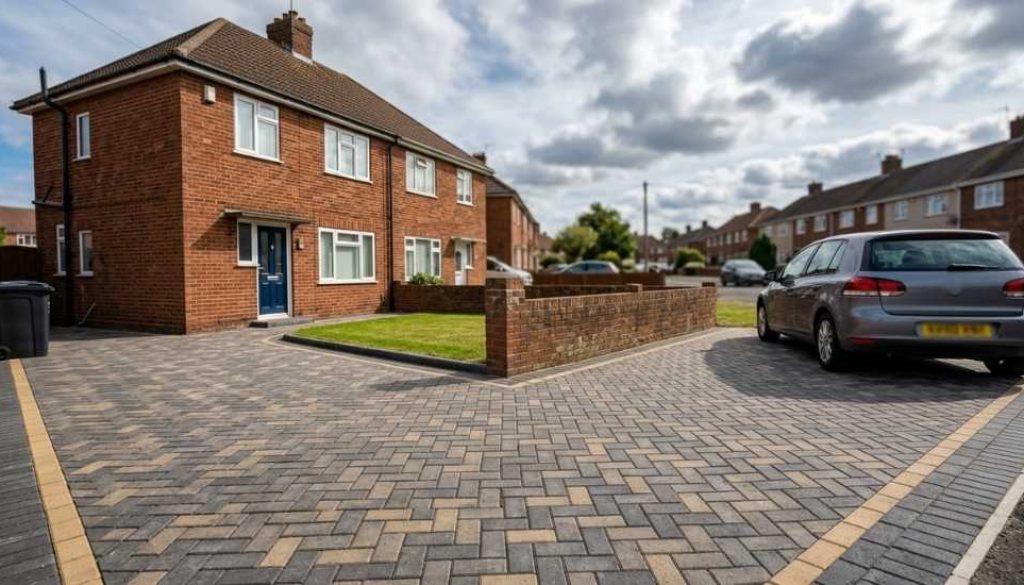
Block Paving vs Imprinted Concrete: Which Suits Your Blyth Home?
Two driveways can cost roughly the same, cover the same area, and still behave completely differently after five winters. That is usually the gap between block paving and imprinted concrete. Both look sharp on the day the team packs up. The difference shows in how they age, how they handle water, and what happens when something goes wrong. If you are weighing up block paving in Blyth against a patterned concrete finish, here is an honest comparison of how each performs on a Northumberland coastal street.
How Each Surface Is Built
The two options share the same starting point and then part ways.
Block paving uses hundreds of separate units bedded on sharp sand over a compacted stone sub-base, held in place by edge restraints and locked together with kiln-dried sand brushed into the joints. Nothing is glued. The strength comes from the blocks pressing against each other.
Imprinted concrete is a single slab of reinforced concrete poured over the same style of sub-base, then stamped with a patterned mat while still wet, coloured, and sealed once cured. It arrives as one continuous surface with no joints at all.
That single difference, many small units against one large one, drives almost everything below.
Standing Up to Coastal Weather
Blyth sits in a genuinely exposed spot. The town hosted the UK’s first offshore wind farm back in December 2000, with two turbines planted in the North Sea less than two kilometres out, chosen partly because the conditions there are so consistently harsh. Your driveway sits in the same salt-laden wind, minus the engineering budget.
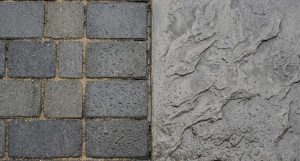
Here is how each surface copes:
- Frost: block paving flexes very slightly with ground movement, since each unit can settle independently. Concrete has no give, so pressure tends to release as a crack.
- Salt and grit: both handle winter salt, though imprinted concrete relies on its sealer for protection. Once that wears thin, the surface is exposed.
- Standing water: permeable block paving lets rain soak through the joints. Concrete sheds every drop to wherever you have directed it.
- Sun and fading: colour pigments in concrete can lighten over years of exposure. Block colours are through the unit rather than on top.
Repairs: The Difference That Turns Up Later
This is where most homeowners end up wishing they had asked more questions.
A damaged block is lifted out with two screwdrivers and replaced. Same colour, same batch if you kept spares, no visible mark. If a service company digs up part of the drive to reach a pipe, the blocks come up and go back down.
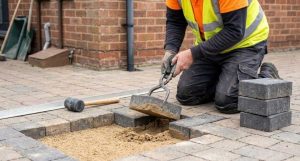
Cracked or stained imprinted concrete is a harder problem. Patch repairs rarely match, because the original colour has weathered and the pattern has to line up. Most repairs stay visible. In some cases the practical fix is resurfacing the whole area.
Block paving also carries an upkeep task people forget: joint sand washes out over time and needs topping up, and weeds will find any joint left empty.
Cost Now and Cost Later
Prices move with size, access and groundwork, so the useful comparison is the shape of the spend rather than a figure.
- Upfront: the two sit close together for a standard drive. Concrete can come in slightly lower on large, simple rectangles, while block paving is often more competitive on smaller or awkward plots.
- Maintenance: imprinted concrete needs resealing every few years to keep its colour and surface protection. Block paving needs occasional re-sanding and a wash down.
- Repairs: blocks are cheap to fix in isolation. Concrete repairs tend to be all or nothing.
- Lifespan: a properly built base carries both for decades. The base is where you should spend, not the finish.
Ask for a quote that separates excavation, sub-base, drainage and surfacing. A single lump sum hides the part that determines how long the drive lasts. Two quotes can look identical on paper while one allows for 150mm of compacted stone and the other for barely half that.
Kerb Appeal and Design
Both give you plenty of choice, in different directions.
Block paving offers pattern and colour combinations: herringbone for strength under vehicle loads, stretcher bond for simplicity, plus contrasting borders and circle features. It suits traditional brick homes, which describes most of Blyth.
Imprinted concrete can imitate cobbles, slate, riven stone or brick across an unbroken surface. The finish is smooth underfoot, easy to sweep, and looks tidy on modern properties. Up close, though, it reads as one printed sheet rather than laid units, which some homeowners like and others do not.
Drainage and Planning Rules
This is the point that decides it for many front gardens, and it catches people out.
A new front driveway over five square metres needs planning permission if it uses an impermeable surface with nowhere for water to soak away. Standard imprinted concrete is sealed and impermeable, so it needs either permission or a compliant drainage plan. Permeable block paving drains through the joints and stays within permitted development at any size.
The workarounds for concrete are real and used all the time: channel drains, soakaways, or falls directed to a lawn or border inside your boundary. They simply need designing in from the start rather than added afterwards. Water can never be sent onto the pavement or road, and crossing the footpath still requires a dropped kerb approved by the council.
Questions to Ask Before You Sign
The surface argument matters less than the workmanship underneath it. Whichever finish you lean towards, put these to any installer quoting for the job:
- How deep will you excavate, and what depth of sub-base is going in?
- What are the falls, and where exactly is the water going?
- Is the surface permeable, and does the design need planning permission?
- Who carries out the work, your own team or subcontractors?
- What guarantee is offered, and what does it actually cover?
- Can I see a drive you laid five or more years ago?
That last one is worth more than any brochure. A surface looks its best on handover day. Seeing one that has already sat through several Northumberland winters tells you what you are really buying.
So Which One Suits Your Home?
A quick way to narrow it down:
- Choose block paving if you want easy repairs, permeable drainage without extra work, a traditional look, or a drive that may need digging up for services later.
- Choose imprinted concrete if you prefer a seamless surface, a smooth sweep-down finish, and you are happy to reseal it periodically and design the drainage in.
- Look at both on site before deciding. Samples in daylight beat photographs every time, and our gallery shows each finish on local homes.
M&C Paving Northeast is based in Blyth and has been laying driveways, patios and landscaping across Northumberland and Tyneside for more than 25 years, using an in-house team rather than subcontractors.
Request a free quote and we will talk through both options at your property.
FAQs
For all your paving and landscaping services…
Call us today – 0191 743 2048