Summer Patio Ideas for Northumberland Gardens
Most gardens get used properly for about four months a year, and August is the month that shows you exactly what your outdoor space is missing. Chairs that wobble on uneven slabs. A table shoved against the house because there is nowhere better. A corner that catches the wind every time you sit in it. Good patios in Northumberland are designed around how a garden actually gets used, not just where the paving happens to fit. Here are the ideas worth borrowing this summer.
Start With How You Use the Garden
Before choosing a single slab, work out what the space needs to do. Most gardens serve two or three jobs at once, and the layout should reflect that.
- Dining: a six-seat table with chairs pulled out needs roughly 3.5m by 3.5m of clear paving. Most patios that feel cramped were simply built too small.
- Sitting and relaxing: softer seating suits a quieter corner, ideally away from the back door and the kitchen window.
- Cooking: a barbecue or pizza oven wants a stable, non-porous surface and a bit of clearance from fencing and planting.
- Children and pets: level, grippy paving with rounded edges matters more than looks.
- Storage and access: bins, bikes and the route to the shed all need a path that does not cut through the seating.
Sketch it out roughly on paper, then put the garden furniture where you think it should go and leave it there for a few days. Ten minutes of planning at that stage saves a lot of regret later.
Choosing Stone for a Northumberland Garden
Material choice affects grip, warmth underfoot and how much cleaning you sign up for.
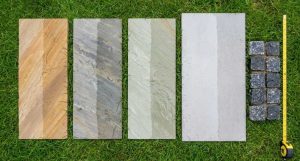
- Indian sandstone: riven, naturally textured and available in buff, grey, mint and multicolour tones. It weathers into a softer look and suits stone-built and older brick properties across the county.
- Porcelain: dense, low-porosity and colour-stable. It resists algae and staining, which counts in shaded northern gardens, and cleans with very little effort.
- Sawn sandstone: the same stone with a cut, uniform finish for a sharper, contemporary look and tighter joints.
- Granite setts: hard-wearing and useful for borders, edging and level changes rather than whole areas.
- Block paving: better suited to paths and utility areas that link the patio to a drive or side gate.
Order samples and leave them outside for a week. Northern light is flat and often grey, and a stone that looks warm in a showroom can read very differently against your own house.
Layouts That Make a Garden Work Harder
A square patio pushed up against the back wall is the default, and it is rarely the best answer.
- Move it away from the house. Site the seating where the evening sun lands, then run a path back to the door.
- Split it in two. A dining area near the kitchen and a smaller sitting area further down gives the garden two destinations instead of one.
- Turn it 45 degrees. Laying paving diagonally draws the eye across the widest line of the plot, which makes narrow gardens feel broader.
- Add a level change. A single low step or a raised section breaks up flat ground and creates natural edges for planting.
- Frame it. A contrasting border course, a sett edge or a planted margin stops the paving from looking like it was dropped in place.
Shelter From the Wind
Exposure is the recurring problem across Northumberland gardens, whether you are near the coast or inland closer to the hills. A beautiful patio you cannot sit on is not much use.
Solid fencing is not always the fix, as wind hits a solid panel and tumbles over the top into the space behind it. Slatted screens, hit-and-miss fencing and hedging filter the wind instead, which calms the air more effectively. Position shelter on the prevailing side, usually the south-west, and check where gaps between buildings funnel gusts through.
Lighting for Long Northern Evenings
Northumberland has an advantage most counties do not. In December 2013, 572 square miles of the county was named an International Dark Sky Park with gold tier status, which makes it the largest area of protected night sky in Europe. Even well outside the park boundary, the skies here are darker than in most of England.
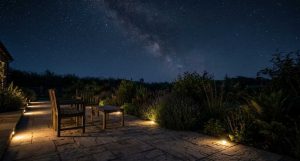
That is worth designing around rather than lighting over. A patio flooded with a single bright floodlight kills both the atmosphere and the view upward.
- Use low-level lighting: recessed deck lights, step lights and shielded wall washers.
- Point light downwards onto the surface, never outwards or up.
- Keep it warm in tone, around 2700K, rather than cold white.
- Put lighting on separate switches so you can use only what you need.
- Run the cabling before the paving goes down, as retrofitting means lifting slabs.
Drainage, Levels and Grip
The unglamorous part determines whether the patio is still good in ten years.
Paving needs a fall of roughly 1 in 80 away from the house so water runs off rather than sitting in puddles or tracking back to the wall. Finished levels must stay at least 150mm below the damp proof course. A proper sub-base, full mortar bedding under each slab and correctly filled joints prevent the rocking and sinking that ruins older patios.
Grip matters too. Smooth, dense stone can turn slick with algae in shaded spots, so look at slip ratings before choosing for a north-facing garden or anywhere near steps.
Extras Worth Building In Now
Anything that involves lifting paving or digging is far cheaper while the team is already on site with plant and materials. These are the additions homeowners most often wish they had included:
- A path linking patio to shed, gate or drive, so the lawn stops wearing into a mud track every winter.
- A raised bed or low retaining wall, which doubles as extra seating when the garden is full.
- An outdoor socket and lighting cabling, buried in ducting before jointing.
- A water butt or outside tap position, planned so the run does not cross the seating.
- Edging and border stone, tying the patio into lawn and planting instead of leaving a raw joint.
- Bin and bike standing, tucked to the side of the house on the same materials.
Each of these adds a modest amount to the quote now and a much larger one later.
Getting It Built This Summer
Late summer suits patio work. The ground is dry, materials are readily available, and there is still time to enjoy the finished space before autumn.
- Book a site visit and get a free written estimate.
- Confirm your stone, layout, levels and drainage plan.
- Agree access, timings and where materials will be stored.
- Add fencing, lighting or landscaping into the same job rather than returning later.
M&C Paving Northeast has been building patios, driveways and gardens across Northumberland, Blyth, Newcastle and the coast for more than 25 years with an in-house team. Our gallery shows recent local projects.
Get in touch to arrange a free quote while August dates remain
FAQs
For all your paving and landscaping services…
Call us today – 0191 743 2048