
Fresh Patterns for Patios: From Herringbone to Hexagon

M&C ADVICE & INSPIRATION
Fresh Patterns for Patios: From Herringbone to Hexagon
Plan your outdoor space
with a clearer picture.

The same paving can look quite different laid in straight rows, a herringbone pattern or a mixed-size layout. The choice becomes easier when you look beyond the sample board: where will the table sit, which edge meets the house, and how many cuts will the border need? Those details shape the finished patio as much as the colour.
For a garden in North Shields, bring the pattern ideas and rough furniture layout to a site visit. Our North Shields patio installation page covers the paving options, thresholds and access details to discuss alongside the design.
Pattern Fundamentals: How Geometry Affects Strength and Style
Patio patterns organise the appearance of a paved area. Herringbone gives small rectangular units a strong visual rhythm, while broad straight courses draw attention to longer lines. The paving system, supporting construction and edges still need to suit the intended use; a pattern alone does not establish strength or tell you what soil lies underneath.
A well-planned motif also controls scale. Small blocks laid in a busy pattern shrink a large terrace to a cosy courtyard, whereas oversized slabs placed in broad bonds widen a narrow path. Recognising these effects early prevents a finished patio from feeling cramped or barren.
Timeless Classics
Before sleek porcelain tiles and bold geometric slabs entered the garden, a handful of tried-and-tested patterns had already earned their place in paving history. These classics—refined through centuries of footfall and fickle weather—pair understated elegance with structural integrity. When you want a patio that feels familiar, complements most property styles and handles the North-East climate without fuss, the following motifs remain unbeatable.
Herringbone
Originally used on Roman roads, herringbone earns its status through sheer resilience. Units laid at 45 ° or 90 ° bite against one another, locking in place under traffic from garden furniture or wheelbarrows.
Why choose it?
- Durability: The interwoven joints spread pressure, ideal for patios that double as driveway aprons.
- Versatility: Works with slim clay bricks, concrete pavers, or reclaimed setts, allowing a heritage feel without strict material rules.
Any settlement, rocking or unevenness still needs attention. A busy pattern can make small visual differences less obvious, but it does not remove a trip hazard or correct movement.
Basket-Weave
Basket-weave alternates pairs of bricks to mimic woven willow. The look softens formal gardens, lending warmth to period terraces and cottage plots.
Laying notes:
- Materials: Tumbled clay bricks or aged concrete blocks showcase subtle colour shifts.
- Joints: Keep sand joints narrow; wide gaps blur the crisp right angles and collect weeds.
The number of cuts depends on the unit dimensions, joint widths and patio outline. Set out the proposed pattern against the actual boundaries before assuming it will save material or labour.
Contemporary Statements
Where classic patterns evoke heritage charm, contemporary layouts push the design envelope, earning immediate attention and forging a seamless link with today’s clean-lined architecture. By manipulating slab size, joint alignment and unconventional shapes, these modern motifs create patios that double as bold outdoor rooms—perfect for extensions with vast glazing, minimalist planting schemes and a desire to stand apart from the neighbours.
Stretcher Bond with Oversized Slabs
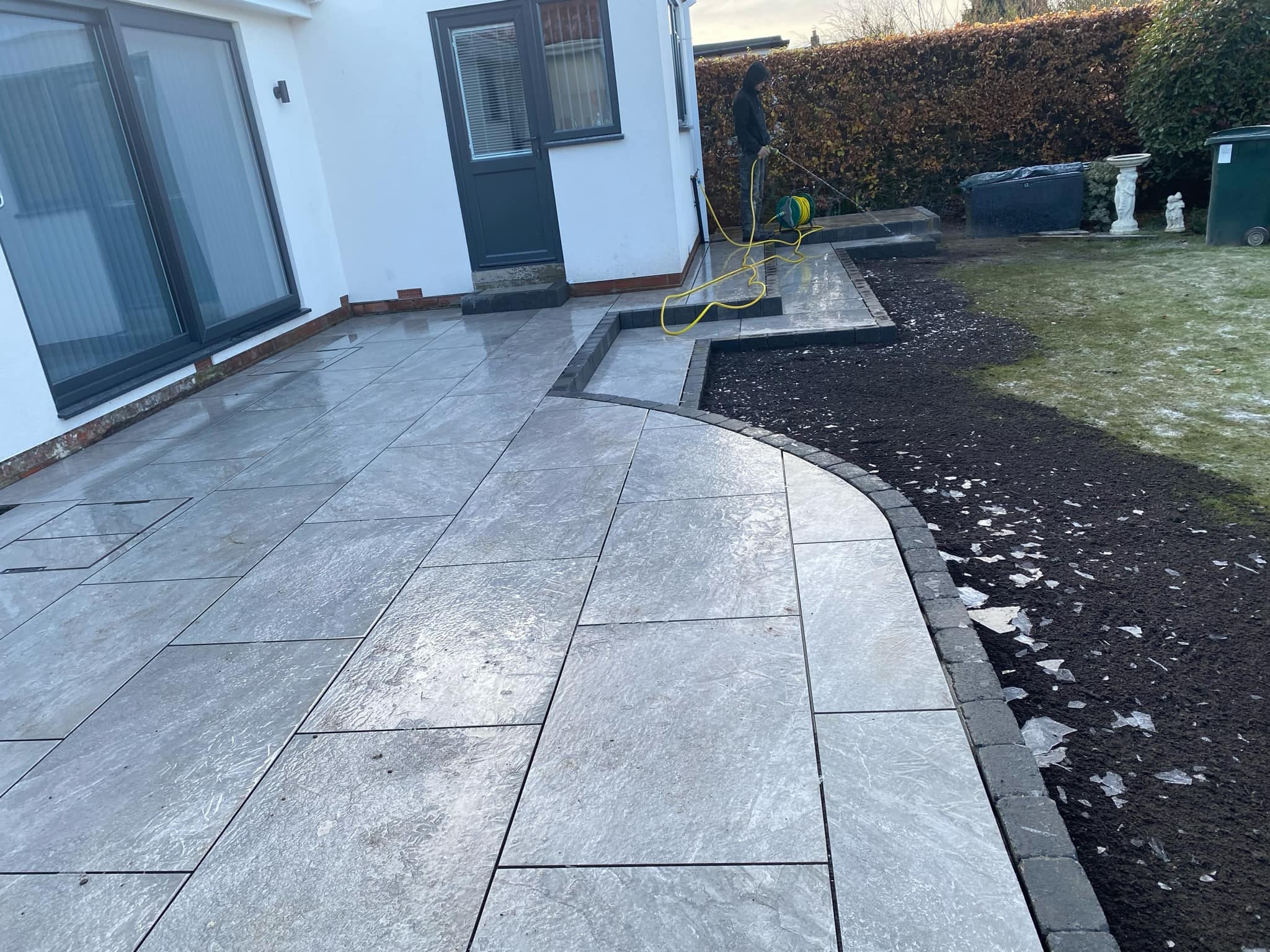
Modern extensions often feature wide bi-fold doors and sleek interiors. Extending that linear calm outdoors is simple: lay porcelain or sawn sandstone in a stretcher bond, but upscale each unit to 900 × 600 mm or larger.
Long joints run parallel to the house, leading the eye outward and unifying indoor and outdoor flooring. Gauged edges let tiles butt with a 5 mm joint, leaving only a neat pencil-line of grout.
Hexagon & Other Modular Shapes
Honeycomb and diamond patterns answer the call for geometry that breaks from straight lines. Pre-cast concrete hexagons slot together with minimal waste, while water-jet-cut limestone offers premium texture for statement zones.
Tips for tidy edges:
- Mark the patio perimeter first, then dry-lay a full row of hexagons to see where partial cuts fall.
- Use a contrasting border course—charcoal bricks or slim granite setts—to frame the irregular outline cleanly.
The result feels bold yet balanced, especially beside contemporary planting schemes.
Mixing Motifs: Feature Bands, Borders and Inlays
Combining patterns personalises a patio without visual overload. A simple approach is a herringbone field bordered by a single soldier course of bricks.
Other ideas include:
- Colour-contrast bands circling a fire-pit area to set seating apart.
- Radial inlays of cobbles as focal medallions within larger porcelain grids.
- Diagonal accents crossing a square patio to draw attention to a garden sculpture.
Careful placement saves off-cuts: a border can absorb size discrepancies, avoiding thin slivers at the perimeter.
Matching Pattern to Home Style and Garden Layout
Architecture should steer the choice of geometry. A Georgian town house suits the order of basket-weave, while a minimalist new-build benefits from broad stretcher bonds.
Plot size plays a role:
- Small courtyards gain depth from diagonal patterns, which lead the gaze corner to corner.
- Large terraces feel cohesive when divided into zones—dining, lounging, cooking—each marked by its own pattern or border.
View samples in the garden and consider surface texture as well as colour. Choose paving intended for outdoor use and assess its suitability for the actual setting; a polished appearance or one slip-rating label is not a guarantee of safe conditions.
Material Compatibility Check
Not every pattern fits every slab or block. Porcelain comes in precise rectangles perfect for straight bonds; its brittle nature makes tight herringbone angles risky without expert cutting. Natural stone, with its slight dimensional tolerances, suits looser-jointed layouts like random coursed or running bond.
Check the selected product’s outdoor suitability, declared performance and installation guidance with its supplier. Natural stone and porcelain have different characteristics, so a porcelain water-absorption threshold should not be used as a universal pass-or-fail rule for stone. Consider wet conditions and maintenance alongside appearance.

Installation Essentials: Sub-Base, Jointing & Drainage
The construction depth follows the site, loads and selected paving system. It cannot be chosen from a pattern name. A pedestrian terrace and a surface used by vehicles need different assessments, even if both use the same-looking rectangular units.
Key points:
- Rigid or flexible construction: Confirm the laying system, bedding, jointing and any movement-joint details for the selected product. These decisions belong in the installation specification, not in a visual pattern sketch.
- Drainage: Plan surface levels, collection points and the water destination together. Visible joints or a channel do not, by themselves, make a patio permeable or establish a suitable drainage arrangement.
Good groundwork makes any pattern last; skimping invites rocking slabs and widening joints within a season.
Maintenance Made Simple
Different jointing systems need different care. Identify what is installed before choosing a cleaning method or topping up joints. Some block systems use jointing sand; a mortar-jointed or compound-jointed patio needs a different approach.
Basic schedule:
- Spring: Low-pressure wash, check for loose units, re-sand if required.
- Summer: Clear spillages and follow the paving supplier’s care instructions. Apply a coating only where it is suitable for the product and the treatment already on the surface.
- Autumn: Sweep leaves promptly; tannins can stain pale limestone.
Modular patterns simplify repair: lift and relay individual units, avoiding large patches that draw the eye.
Finishing Touches – Bring Your Dream Pattern to Life
A patio pattern is the blueprint for outdoor living. Herringbone offers time-tested strength, basket-weave evokes heritage charm, and hexagon lends contemporary flair. Pair the right geometry with suitable materials, solid foundations, and straightforward upkeep, and your terrace will serve as a stylish stage for years to come.
For expert advice on patio paving patterns North East and a free site survey, contact M&C Paving Northeast. Our team designs, sources and installs patios tailored to your home and budget—whether classic, modern, or firmly one-of-a-kind. Visit our contact page to start planning your perfect pattern today.
For other connected garden work, see our North Shields services.
For the selected product’s care guidance, see Marshalls’ technical information. Use the guidance for your own paving and jointing where the product is different.
For the wider options, see our Patio Installation page. The right specification depends on your property and the work agreed at survey.
Ready to discuss your own project? Contact M&C Paving Northeast to arrange a free site visit and quote.
Frequently asked questions
Does herringbone make any patio stronger?
Herringbone describes how the units are arranged. Its suitability depends on the paving product and the complete construction, including the supporting layers, joints and edges. It does not establish the ground condition or make pedestrian slabs suitable for vehicle use.
Choose the appearance alongside the installation specification, particularly where a patio connects with a drive or a route carrying heavier loads.
Will a diagonal pattern make a small patio bigger?
It may change how the eye reads the space, but it cannot create more room for chairs or a walking route. Mark out the furniture first and compare a scaled drawing of the paving options.
Look at the border cuts and the main view from the house. A calm layout with well-resolved edges may work better than a busy pattern chosen only for an optical effect.
How do I avoid awkward cuts at the edges?
Ask to see how the selected unit sizes and joints fit the actual patio dimensions before laying begins. Doorways, steps, inspection covers and borders affect the setting out. Adjusting a starting line or border may resolve a narrow cut, but the solution must suit the product.
A drawing or trial arrangement is more useful than assuming that a particular pattern produces little waste.
Can porcelain be laid in the same patterns as blocks?
Only where the product dimensions and installation guidance allow it. A pattern illustrated with small concrete blocks may not transfer neatly to large porcelain slabs. Joint widths, permitted offsets, cutting and bedding details can differ.
Confirm the layout for the exact paving you are buying. The photograph establishes a look; it does not provide an installation specification for another material.
Should the border match the patio or contrast with it?
Either can work. A matching border gives a quieter finish, while contrast can define an edge or separate seating from a path. View samples beside the house and think about the whole outline, including steps and planting.
Agree the dimensions and construction too. A decorative colour change does not replace any restraint or other edge detail required by the selected paving system.
FROM IDEAS TO YOUR OUTDOOR SPACE
Ready to take the next step?
Talk to M&C about the work you have in mind.
A patio is more than an outdoor floor; it frames the garden, guides foot traffic, and sets the mood for gatherings. The laying pattern you choose can strengthen the surface, stretch a modest budget, and echo the lines of your home. For home-owners seeking patio paving patterns North East fit for local weather, the right geometry will prove as important as the stone or brick itself.
Pattern Fundamentals: How Geometry Affects Strength and Style
Patio patterns work on two levels. First, their interlock distributes load, reducing movement on clay-rich North-East soils. Second, the eye senses rhythm; tight zig-zags feel energetic, while long, straight courses calm the space.
A well-planned motif also controls scale. Small blocks laid in a busy pattern shrink a large terrace to a cosy courtyard, whereas oversized slabs placed in broad bonds widen a narrow path. Recognising these effects early prevents a finished patio from feeling cramped or barren.
Timeless Classics
Before sleek porcelain tiles and bold geometric slabs entered the garden, a handful of tried-and-tested patterns had already earned their place in paving history. These classics—refined through centuries of footfall and fickle weather—pair understated elegance with structural integrity. When you want a patio that feels familiar, complements most property styles and handles the North-East climate without fuss, the following motifs remain unbeatable.
Herringbone
Originally used on Roman roads, herringbone earns its status through sheer resilience. Units laid at 45 ° or 90 ° bite against one another, locking in place under traffic from garden furniture or wheelbarrows.
Why choose it?
- Durability: The interwoven joints spread pressure, ideal for patios that double as driveway aprons.
- Versatility: Works with slim clay bricks, concrete pavers, or reclaimed setts, allowing a heritage feel without strict material rules.
Regular lines also hide minor settlement; any vertical movement is broken up rather than forming long trip hazards.
Basket-Weave
Basket-weave alternates pairs of bricks to mimic woven willow. The look softens formal gardens, lending warmth to period terraces and cottage plots.
Laying notes:
- Materials: Tumbled clay bricks or aged concrete blocks showcase subtle colour shifts.
- Joints: Keep sand joints narrow; wide gaps blur the crisp right angles and collect weeds.
Because units sit in pairs, basket-weave uses fewer cuts along edges, saving time and waste on compact patios.
Contemporary Statements
Where classic patterns evoke heritage charm, contemporary layouts push the design envelope, earning immediate attention and forging a seamless link with today’s clean-lined architecture. By manipulating slab size, joint alignment and unconventional shapes, these modern motifs create patios that double as bold outdoor rooms—perfect for extensions with vast glazing, minimalist planting schemes and a desire to stand apart from the neighbours.
Stretcher Bond with Oversized Slabs
Modern extensions often feature wide bi-fold doors and sleek interiors. Extending that linear calm outdoors is simple: lay porcelain or sawn sandstone in a stretcher bond, but upscale each unit to 900 × 600 mm or larger.
Long joints run parallel to the house, leading the eye outward and unifying indoor and outdoor flooring. Gauged edges let tiles butt with a 5 mm joint, leaving only a neat pencil-line of grout.
Hexagon & Other Modular Shapes
Honeycomb and diamond patterns answer the call for geometry that breaks from straight lines. Pre-cast concrete hexagons slot together with minimal waste, while water-jet-cut limestone offers premium texture for statement zones.
Tips for tidy edges:
- Mark the patio perimeter first, then dry-lay a full row of hexagons to see where partial cuts fall.
- Use a contrasting border course—charcoal bricks or slim granite setts—to frame the irregular outline cleanly.
The result feels bold yet balanced, especially beside contemporary planting schemes.
Mixing Motifs: Feature Bands, Borders and Inlays
Combining patterns personalises a patio without visual overload. A simple approach is a herringbone field bordered by a single soldier course of bricks.
Other ideas include:
- Colour-contrast bands circling a fire-pit area to set seating apart.
- Radial inlays of cobbles as focal medallions within larger porcelain grids.
- Diagonal accents crossing a square patio to draw attention to a garden sculpture.
Careful placement saves off-cuts: a border can absorb size discrepancies, avoiding thin slivers at the perimeter.
Matching Pattern to Home Style and Garden Layout
Architecture should steer the choice of geometry. A Georgian town house suits the order of basket-weave, while a minimalist new-build benefits from broad stretcher bonds.
Plot size plays a role:
- Small courtyards gain depth from diagonal patterns, which lead the gaze corner to corner.
- Large terraces feel cohesive when divided into zones—dining, lounging, cooking—each marked by its own pattern or border.
Sunlight also matters. Low northern light highlights surface textures; deep joints in riven sandstone cast pleasant shadows, whereas polished porcelain looks best where direct sun can bounce off its sheen.
Material Compatibility Check
Not every pattern fits every slab or block. Porcelain comes in precise rectangles perfect for straight bonds; its brittle nature makes tight herringbone angles risky without expert cutting. Natural stone, with its slight dimensional tolerances, suits looser-jointed layouts like random coursed or running bond.
For the North-East climate, select frost-rated stone (usually with a water absorption of ≤ 0.5 %) and porcelain with a grip rating of R 11 or higher to stay safe in summer showers. Brick fares well provided joints are well-packed and the clay grade is engineering or paving class.
Installation Essentials: Sub-Base, Jointing & Drainage
Pattern affects build-up depth. Herringbone acting as light vehicular surfacing needs a 150 mm well-compacted Type 1 sub-base, whereas a lightly loaded basket-weave terrace can manage with 100 mm on stable ground.
Key points:
- Rigid vs flexible: Rigid layouts (mortar-bed porcelain) resist weed growth but require expansion joints; flexible systems (sand-bedded clay) tolerate slight movement.
- Drainage: Porous joints or discreet ACO channels prevent standing water, meeting SUDS guidelines and protecting grout from freeze damage.
Good groundwork makes any pattern last; skimping invites rocking slabs and widening joints within a season.
Maintenance Made Simple
Different joints need different care. Resin-bound or polymer-sand joints in porcelain resist weeds and only need an annual rinse. Traditional kiln-dried sand in block paving benefits from seasonal top-ups after winter wash-out.
Basic schedule:
- Spring: Low-pressure wash, check for loose units, re-sand if required.
- Summer: Apply breathable sealant on porous stone to lock in colour and repel barbecue spills.
- Autumn: Sweep leaves promptly; tannins can stain pale limestone.
Modular patterns simplify repair: lift and relay individual units, avoiding large patches that draw the eye.
Finishing Touches – Bring Your Dream Pattern to Life
A patio pattern is the blueprint for outdoor living. Herringbone offers time-tested strength, basket-weave evokes heritage charm, and hexagon lends contemporary flair. Pair the right geometry with suitable materials, solid foundations, and straightforward upkeep, and your terrace will serve as a stylish stage for years to come.
For expert advice on patio paving patterns North East and a free site survey, contact M&C Paving Northeast. Our team designs, sources and installs patios tailored to your home and budget—whether classic, modern, or firmly one-of-a-kind. Visit our contact page to start planning your perfect pattern today.


