What Happens Under Your Driveway After a Wet North East Winter?
Most homeowners judge a driveway by what’s visible. If it looks level, clean, and free from cracks, it feels like everything is holding up well. On the surface, that assumption makes sense.
But the real condition of your driveway is decided underneath.
The sub-base is the structural layer that carries weight, handles moisture, and keeps everything stable over time. It is doing the heavy lifting every single day, even though you never see it. After a wet North East winter, that layer often takes more strain than the surface reveals.
You could be walking or driving over a structure that is already compromised without realising it. And by the time visible damage appears, the problem has usually been building for months.
How a Wet Winter Changes the Ground
A driveway does not fail overnight. It weakens gradually, starting below the surface.
Rain does not stay where it lands. It finds its way through joints, edges, and small imperfections that are impossible to fully seal. Even well-installed driveways allow a degree of water movement, which is why proper drainage and base preparation are so important.
Over weeks of consistent rainfall, the ground beneath becomes saturated. When this happens, several structural changes begin to take place:
- The sub-base loses its compacted strength
- Fine materials begin to shift and separate
- Load-bearing capacity drops under repeated pressure
- Water pockets form in weaker areas
Think of it like walking across soaked sand at the beach. At first, it feels firm. But the moment you apply weight, it gives way under your foot. The same principle applies beneath your driveway.
The difference is that, unlike sand, this movement is happening under a fixed structure. Every time a vehicle drives over it, pressure is applied unevenly. Over time, those small shifts turn into measurable movement.
This is why winter is not just a seasonal inconvenience. It is a stress test for your driveway’s foundation.
Why Freeze and Thaw Make It Worse
Water on its own causes problems, but when freezing temperatures are introduced, those problems accelerate.
When water trapped within the sub-base freezes, it expands. This expansion pushes apart the compacted materials, creating tiny gaps within the structure. These gaps are not visible from above, but they weaken the integrity of the base.
When temperatures rise, the ice melts. However, the structure does not return to its original state. The gaps remain.
This cycle repeats throughout winter:
- Water enters
- Freezing expands it
- Thawing leaves voids
- The base becomes less stable
Each cycle chips away at the strength of the foundation. By the time spring arrives, the sub-base may no longer provide consistent support across the entire driveway.
That is why many issues appear after winter rather than during it. The damage is already done. It simply becomes visible once regular use resumes.
The Early Signs That Point to Sub-Base Problems
By March, the effects of winter begin to show on the surface. These signs are often subtle, which is why they are frequently ignored.
You might notice:
- Sections that feel slightly soft underfoot
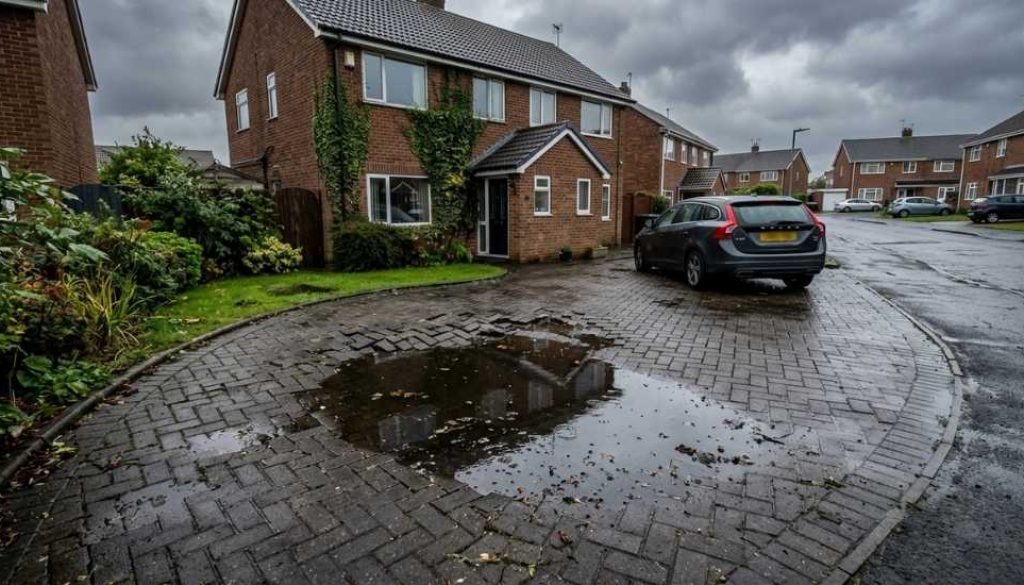
- Uneven areas where water starts to collect
- Subtle dips forming along tyre paths
- Movement when vehicles pass over certain spots
- Edges that begin to lose their straight lines
Individually, these issues can seem minor. A small dip or a patch of standing water does not feel urgent.
But these are not surface-level problems. They are early indicators that the sub-base is no longer doing its job properly.
Ignoring them is like ignoring a slight wobble in a chair. It may still hold your weight for now, but the structure is already compromised.
A Typical Scenario After Winter
A common pattern plays out across many homes in the North East.
A homeowner notices that rainwater is sitting in one corner of the driveway where it never used to. At first, it seems like a minor drainage issue.
Weeks pass, and that same area starts to feel slightly uneven. Vehicles driving over it cause further compression because the ground underneath is no longer firm.
By late spring, the dip becomes more visible. Blocks may begin to shift out of alignment, and the once-clean finish starts to lose its structure.
What started as water saturation during winter has now developed into structural movement.
And at this stage, the problem is no longer cosmetic. It is foundational.
Why Proper Construction Prevents These Issues
Driveways that hold up well after winter are not just built to look good. They are built to manage water, pressure, and seasonal change from the ground up.
That starts long before the surface is installed.
A properly constructed driveway includes:
- Sufficient excavation depth to remove unstable soil
- A well-layered sub-base using the correct aggregate
- Mechanical compaction to eliminate air pockets
- Accurate levels and falls to guide water away
- Drainage solutions that prevent water build-up beneath the surface
Skipping any of these steps increases the risk of long-term failure.
At M&C Paving Northeast, groundwork is treated as the most important part of every project. The surface finish matters, but it is only as strong as what sits beneath it.
A driveway built on a weak base is like laying tiles over a sponge. It may look neat on day one, but it will not stay that way for long.
When Repairs Are Needed
If the sub-base has been compromised, surface fixes will not last.
Repair usually involves:
- Lifting affected areas
- Removing weakened material
- Rebuilding and compacting a stable base
- Reinstalling the surface properly
This restores the structure rather than masking the issue.
Bottomline
After a wet winter, your driveway may not be as stable as it looks.
March is the point where small changes start to appear. Acting early keeps repairs contained and prevents further movement.
If your driveway feels different this spring, it is worth taking seriously. What lies beneath is often where the real problem begins.
What to Do Next?
If your driveway has started to dip, shift, or hold water after winter, now is the time to check it properly.
M&C Paving Northeast focuses on solid groundwork and long-term performance, ensuring repairs address the cause, not just the surface.
Book your assessment today and avoid bigger issues later in the year.