Indian Sandstone or Porcelain: Which Patio Suits You?
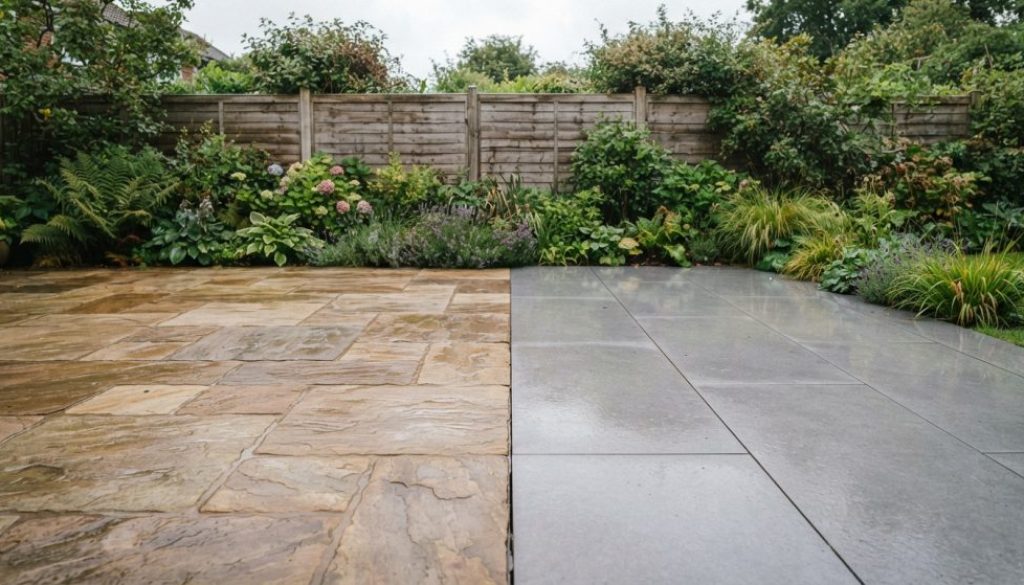
Most patio projects stall at the same point. The layout is agreed, the budget is roughly settled, and then the material question arrives. Indian sandstone vs porcelain paving is the comparison North East homeowners raise more than any other, usually after seeing both in a showroom and finding them equally appealing. They are genuinely different products, though, and the differences show up in upkeep, grip and installation rather than in how they look on day one.
Choosing well means being honest about how much maintenance you actually want to do.
If you want to skip ahead, the decision usually comes down to two priorities.
- Choose Indian sandstone if you want natural variation, warm earthy tones and a lower material cost, and you are content to clean and seal it periodically.
- Choose porcelain if you want a consistent, low-upkeep surface with sharp edges and predictable colour, and you are prepared to pay more up front for it.
Everything below explains why those two summaries hold, and where each material can catch you out.
How Each Material Behaves
The two products come from opposite directions. One is quarried stone with all the variation that implies. The other is manufactured to a specification.
Indian Sandstone
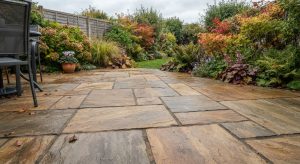
Sandstone is a natural, porous stone, which means water and staining agents can penetrate the surface. It is supplied in riven finishes, where the natural split gives texture, and sawn finishes, which are smoother and more contemporary.
Its character is appealing. No two slabs match exactly, tones vary across a pallet, and the colour mellows as the surface weathers into a patina. Many homeowners prefer the aged look. Those who want the original colour preserved use an impregnating sealer, which slows the process rather than stopping it.
The trade-off is porosity. Sandstone absorbs moisture, so it holds algae more readily than porcelain and can suffer surface flaking through repeated freezing and thawing if the stone is poorly specified or left unsealed. Well-calibrated stone from a reputable supplier, laid properly and looked after, performs in British gardens for decades.
Porcelain
Outdoor porcelain is fired to a dense, close to non-porous body with water absorption typically under 0.5%. That single property drives nearly all of its advantages. Stains cannot penetrate, water cannot freeze inside the slab and crack it, and algae has very little to grip.
Colour is consistent because it is manufactured rather than quarried, and slabs are calibrated to a uniform thickness with square, precisely cut edges. Sealing is unnecessary, since there is nothing for a sealer to bond to.
There is one quirk worth knowing. Because porcelain holds almost no moisture, there is nothing to evaporate and cool the surface, so a porcelain patio in full sun retains heat noticeably more than natural stone. On a south-facing terrace used barefoot, that is worth factoring in.
Comparing the Two Side by Side
Set against each other, the practical differences become easier to weigh.
|
Consideration |
Indian sandstone |
Porcelain |
|
Appearance |
Natural variation, warm earthy tones, changes with age |
Consistent colour and pattern, stays as supplied |
|
Porosity |
Porous, absorbs water and staining |
Water absorption typically under 0.5% |
|
Sealing |
Benefits from periodic sealing |
Not required |
|
Algae and moss |
More prone, particularly in shade |
Far less prone, little for growth to grip |
|
Grip when wet |
Good on riven finishes, less so on smooth sawn |
Reliable when specified with an outdoor slip rating |
|
Cutting and laying |
Straightforward, more tolerance for adjustment |
Needs diamond cutting and a primed, accurate bed |
|
Frost behaviour |
Depends on stone quality and sealing |
Highly frost resistant due to low absorption |
|
Upfront cost |
Generally lower for the material |
Generally higher, and slightly more to install |
|
Long-term upkeep |
Cleaning and resealing |
Occasional washing |
Neither column is the winner. They suit different households and different gardens.
Grip in Wet Weather
This matters more in the North East than in drier parts of the country, and it is where the sales conversation often gets vague.
Outdoor porcelain is normally supplied with a declared slip rating, and R11 is the standard specification for external paving. Slabs sold without any stated rating may be indoor tiles, which are unsuitable outdoors and vulnerable to frost. The other figure worth asking about is the wet pendulum test value, where 36 and above is widely treated as a low slip risk.
With sandstone, the finish decides it. Riven stone has natural texture and grips well when wet. Sawn and honed finishes are smoother and can become slippery once an algae film develops, which happens fastest in shaded corners. Buy only stone with a declared slip rating, and treat unusually cheap pallets with suspicion, since thickness and quality vary widely.
Grip also depends on keeping the surface clean, and both materials benefit from the safety checks covered in our guide to spotting loose slabs and trip hazards.
Installation Differences That Affect the Quote
Two patios of the same size can carry different prices purely because of the material, and the reasons are technical rather than arbitrary.
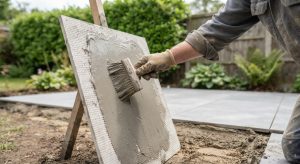
- Porcelain must be primed. Every slab needs a slurry primer applied to the back before bedding, because the low porosity gives mortar almost nothing to bond to. Skipping this step is a common shortcut and it causes slabs to sound hollow, then lift.
- Cutting takes longer. Porcelain requires a good diamond blade and a slower pace. Sandstone cuts more easily.
- The base must be more accurate. Calibrated porcelain is a uniform thickness, so there is little scope to adjust individual slabs in the mortar bed. Any inaccuracy underneath shows on the surface.
- Jointing differs. Porcelain needs a flowable compound suited to narrow joints, since brush-in products intended for natural stone can leave residue on the surface. Kiln-dried sand belongs on block paving, not on a mortar-bedded slab patio.
- Thickness matters. Twenty millimetres is the established outdoor standard for porcelain in the UK.
None of this makes porcelain difficult. It makes it less forgiving, which is an argument for using a contractor who lays it regularly.
Cost, Upkeep and the Long View
Sandstone generally costs less to buy and slightly less to lay, so the gap at quote stage is real. Over ten or fifteen years the picture changes, because sealing, cleaning products and time all carry a cost of their own.
Ask yourself where the money is better spent in your case:
- A large patio on a tight budget usually favours sandstone.
- A household with little time or appetite for maintenance usually favours porcelain.
- A shaded, damp garden where algae returns quickly leans towards porcelain.
- A period property or cottage-style garden often looks better in natural stone.
- A modern extension with large glazed doors tends to suit the crisp lines of porcelain.
One point of caution with new sandstone: efflorescence, the white bloom of mineral salts, needs to clear before sealing. Sealing over it traps the problem in place.
Choosing for Your Own Garden
Before committing, work through five questions honestly.
- How much shade does the area get, and how long does it stay wet?
- Will the patio be used barefoot, or in full sun for long periods?
- How much annual maintenance are you realistically prepared to do?
- Does the style need to sit alongside existing stone or brickwork?
- Is the priority the lowest cost now or the lowest effort later?
The answers usually make the decision obvious. If they do not, look at both materials wet rather than dry, since that is when the difference in colour and grip is clearest. Our guidance on planning a patio around how the garden is used covers the layout side, and patio ideas for smaller gardens are worth a look if space is tight.
Making the Decision With Confidence
The Indian sandstone vs porcelain paving question has no single right answer. Sandstone offers natural character, warmth and a lower entry cost, with periodic sealing as the price of admission. Porcelain offers consistency, frost resistance and minimal upkeep, with a higher cost and a less forgiving installation. Both last a long time when the groundwork underneath is done properly, which remains the part that decides everything.
M&C Paving Northeast lays both across Blyth, Newcastle, Sunderland and Northumberland, including Indian stone paving and porcelain, and can show you samples in the conditions your garden actually experiences. If you are planning patio work for a North East home, get in touch and we will talk through the options for your site, your shade and your budget before anything is ordered.
FAQs
For all your paving and landscaping services…
Call us today – 0191 743 2048