Tree Roots Lifting Your Driveway or Patio? What to Do Next
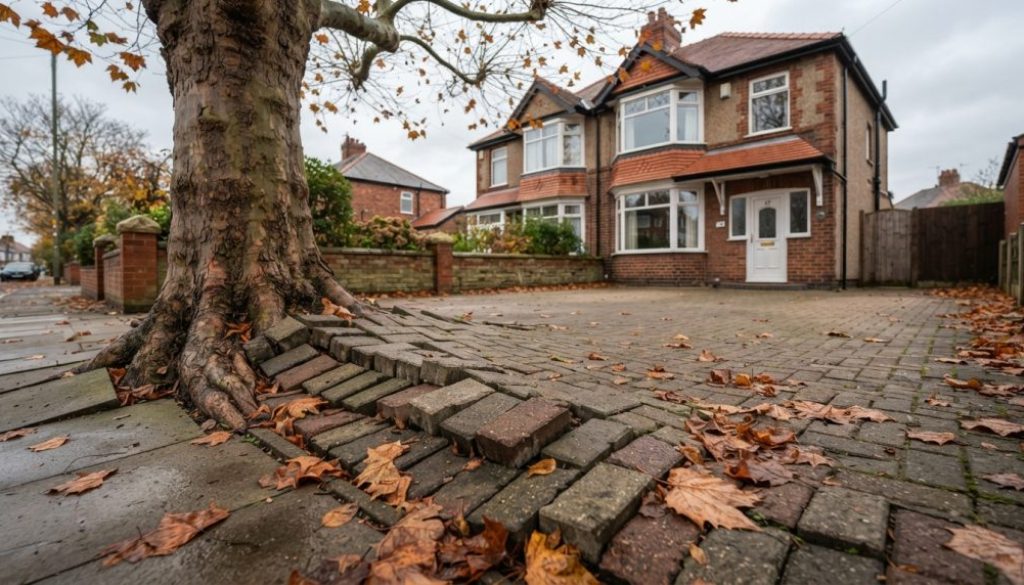
October strips the leaves and shows you exactly where every tree sits in relation to your paving. For many North East homeowners, that is when the connection clicks. The ridge across the driveway, the slab that rocks by the back door and the crack that keeps widening all line up with the tree next to them.
Tree roots lifting a driveway or patio is a different problem from paving that sinks, and it needs a different fix. Relaying the blocks without dealing with the root simply resets the clock. The steps below show how to confirm roots are to blame, what you are legally allowed to do, and which repairs actually last.
How Tree Roots Get Under Paving
Most people picture tree roots plunging deep into the ground. In reality, arboricultural guidance puts the majority of a tree’s root system in the top 600mm of soil. That is the same depth a driveway or patio is built in.
So your paving is not sitting above the tree’s roots. It is sitting among them.
The layers under paving also suit roots well. Roots need oxygen as well as water, and the bedding sand and sub-base beneath blocks or slabs are looser and more open than compacted clay. Rainwater runs through the joints, collects under the surface, and the roots follow it. As each root thickens year on year, it pushes the surface up from below.
The British Standard used when building near trees, BS 5837, gives a sense of the scale. It sets a root protection area with a radius of twelve times the trunk diameter, measured 1.5 metres above ground. A tree with a 30cm trunk has a protection zone stretching 3.6 metres in every direction, which covers a large part of most front gardens.
Signs It Is Roots and Not Subsidence
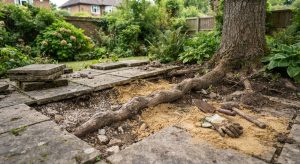
Lifting and sinking can look similar at a glance, but the patterns are different. Before deciding on a repair, check what the surface is actually doing.
Signs Pointing to Roots
- A raised ridge or hump rather than a dip.
- Damage that runs in a line from the direction of a tree.
- Blocks or slabs pushed upwards and tilted, often with wider joints along one side.
- Cracks in concrete or tarmac that radiate from a raised point.
- Problems get steadily worse each year rather than appearing after heavy rain.
Signs Pointing to Sinking
- Dips, hollows and puddles that sit in the same place.
- Edges dropping away from the kerb.
- Damage with no tree nearby.
If you are seeing dips rather than humps, our guide on why some driveways sink over time covers the causes. Edge damage has its own explanation in our article on why driveway edges fail first.
Check the Rules Before Cutting Any Roots
It is tempting to lift the paving, find the offending root and saw through it. That can land you in legal trouble and, in some cases, make the tree unsafe.
Work through these checks first:
- Who owns the tree? If it belongs to a neighbour or stands on the pavement, speak to them or the council before doing anything. Street trees are usually the council’s responsibility, and many councils have a process for reporting damage.
- Is it protected by a Tree Preservation Order? A TPO makes it an offence to damage the tree, which includes cutting its roots, without council consent.
- Are you in a conservation area? Trees with a trunk over 75mm in diameter, measured 1.5 metres above ground, are protected. You must give the council six weeks’ written notice before carrying out work, including root pruning.
- How big is the root and how close is it to the trunk? Cutting large roots near the base can weaken a tree’s anchorage. An arboricultural assessment is worth paying for before removing anything substantial.
Your council’s planning team can confirm whether a tree is protected or whether your property falls within a conservation area.
Repair Options That Actually Last
Once you know the root situation and what is permitted, the right repair depends on the size of the root, the surface you have and how close the tree is.
Relay at an Adjusted Level
Where a root has caused a gentle rise and can stay, the paving can be lifted and relaid with a smooth transition over the area. This works particularly well with block paving, which can be lifted and put back without obvious patching.
Install a Root Barrier
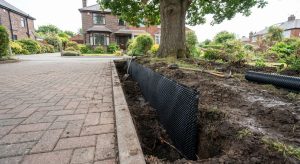
A vertical root barrier set into the ground between the tree and the paving redirects new root growth downwards and away. It suits situations where existing roots can be pruned with consent and the aim is to stop the problem returning.
Bridge Over the Roots
Near valuable or protected trees, specialist no-dig construction methods, such as cellular confinement systems, allow a surface to be built above the root zone with minimal excavation. This needs careful design and is usually agreed with an arboricultural consultant.
Remove the Tree
Sometimes the tree is simply in the wrong place. Removal is a last resort and needs the right permissions where protection applies, but it can be the only permanent answer when a large tree sits right beside a driveway.
Which Surfaces Cope Best With Tree Roots?
Every surface will eventually lift if a growing root sits beneath it. The difference is how the damage shows and how easily it can be put right.
|
Surface |
How Root Damage Shows |
Ease of Repair |
|
Block paving |
Raised ridges and tilted blocks |
Good, as blocks can be lifted and relaid |
|
Flag patio |
Rocking or cracked slabs |
Moderate, as slabs can be relaid or replaced |
|
Imprinted concrete |
Cracking from the raised point |
Difficult, as patches rarely match |
|
Tarmac |
Bulges and spreading cracks |
Moderate, but patches tend to show |
|
Resin bound |
Cracking across the surface |
Difficult to repair invisibly |
Near trees, a flexible surface such as block paving that can be lifted and relaid usually makes the most practical choice, because future adjustments do not mean breaking out the whole drive.
Why Autumn Is a Good Time to Act
Autumn and winter suit this kind of work for several reasons. With the leaves gone, the tree’s size and spread are easy to see. Arboricultural work is often scheduled for the dormant months. Six weeks’ notice given in October also means a conservation area decision can arrive well before spring.
Planning now also gives you time to get a proper survey. A thorough contractor should look at the tree, the root position and the ground conditions together. Our article on what a proper site assessment covers explains what that should involve.
Getting Root-Damaged Paving Fixed Properly
Tree roots lifting a driveway will not settle back on their own, and a quick relay without tackling the cause rarely lasts more than a season or two. Confirm the cause, check ownership and protection, then choose a repair that matches the tree and the surface.
Our experienced driveway contractors can assess root-damaged paving, work alongside your arborist where needed, and recommend a surface that copes with the tree rather than fighting it. We carry out driveway work in Northumberland and across the North East, along with patio repairs and relaying where roots have reached the back garden.
Book a paving assessment to talk through the options for your property.
FAQs
For all your paving and landscaping services…
Call us today – 0191 743 2048