The Real Reason Some Driveways Sink (And How to Prevent It)
When a driveway starts to dip or feel uneven, many homeowners assume it is simply part of ageing. After all, outdoor surfaces deal with constant use, changing weather, and the weight of vehicles every day.
But in most cases, sinking is not about age. It is about what happened long before the surface was ever used.
The visible dip is just the final stage of a much earlier problem. By the time it appears, the structure underneath has already been compromised.
It is similar to a floorboard that suddenly creaks when you step on it. The sound is not the issue itself. It is a signal that something beneath has shifted out of place. The same applies to your driveway. What you see on the surface is only the symptom.
Understanding the real cause is what allows you to prevent it from happening again.
The Most Common Cause: Weak or Inadequate Sub-Base
The sub-base is the foundation of your driveway. It carries the load, distributes pressure, and keeps the surface stable over time.
If this layer is not built correctly, everything above it is at risk.
Several common issues lead to failure:
- Insufficient excavation depth for the expected load
- Poor compaction during installation
- Use of incorrect or low-quality materials
- Rushed groundwork that skips proper layering
Each of these problems weakens the structure in a different way, but the outcome is the same.
Over time, vehicles apply repeated pressure to the surface. That pressure transfers directly to the sub-base. If the base is not strong enough, it begins to compress unevenly.
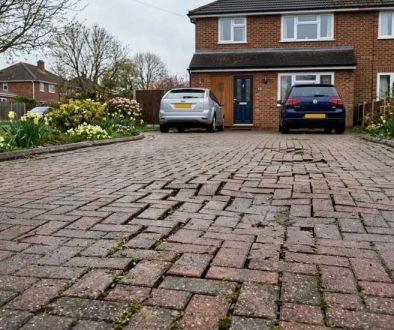
At first, this movement is barely noticeable. The driveway may still look level, and most homeowners would not detect any issue. But with continued use, the weak areas start to give way.
What begins as a slight dip gradually becomes a visible depression. And because the surface follows the condition of the base, it cannot correct itself.
This is why a well-built sub-base is not just important. It is the entire reason a driveway holds its shape over time.
Water Is the Quiet Cause Behind Most Failures
While poor groundwork creates the conditions for sinking, water is often what accelerates the problem.
In many cases, driveway failure is not caused by a single event. It is the result of repeated exposure to moisture combined with pressure.
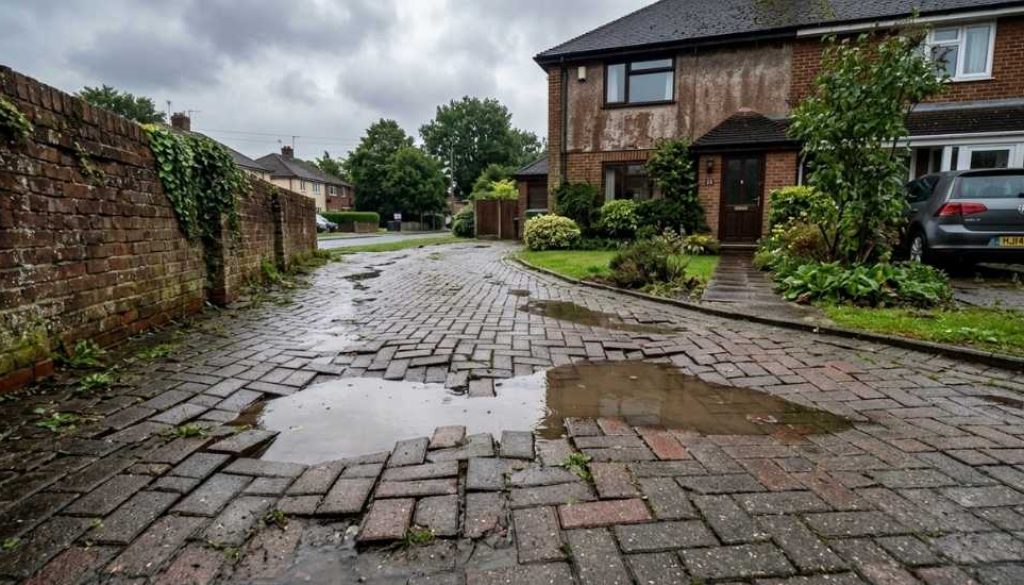
When drainage is inadequate, water seeps through joints and edges into the layers below. Once there, it begins to weaken the compacted materials.
Saturated ground behaves very differently from dry ground:
- It loses its ability to support weight consistently
- It becomes more prone to shifting under pressure
- It allows materials to separate and settle unevenly
After heavy rainfall, this effect becomes more noticeable. The same driveway that felt firm before may now feel slightly softer in certain areas.
Now add vehicle weight into that equation.
Every time a car is parked or driven over the surface, pressure is applied to already weakened ground. Over time, this leads to gradual compression in specific spots, especially where vehicles regularly sit.
A simple way to picture this is to compare placing a heavy object on dry soil versus wet soil. On dry ground, the weight is distributed evenly. On wet ground, it sinks.
This is why drainage is not just a finishing detail. It is a structural requirement.
Why Edges Matter More Than Most People Think
Edges are one of the most overlooked parts of a driveway, yet they play a critical role in maintaining its shape.
Edge restraints act as a boundary that keeps the entire structure locked in place. Without them, the surface has nothing to hold it together under pressure.
Over time, this leads to gradual outward movement:
- Blocks begin to spread apart
- Gaps form along the edges
- The structure loses its tight, compacted form
- Pressure is no longer distributed evenly
This outward movement often starts subtly. You might notice slight widening along the edges or small shifts in alignment.
As this continues, the internal structure weakens further. Areas that were once supported begin to sink because the surrounding material is no longer holding firm.
A driveway without proper edging is like a book without bookends. Everything slowly moves out of place, even if it looks stable at first glance.
Strong edge restraints are what keep the entire system working as a single unit.
A Common Homeowner Scenario
Many homeowners experience the same pattern without realising what caused it.
A new driveway is installed and looks perfect. The surface is level, clean, and performs well during the first year or two.
Then, small changes begin to appear.
A slight dip forms where a car is parked most often. At first, it is easy to ignore. It does not affect usability, and the rest of the driveway still looks fine.
After a period of heavy rain, that same area starts to hold water. The dip becomes more noticeable, and the surface no longer drains as it should.
Over time, the issue spreads:
- Blocks may shift slightly out of alignment
- The surface begins to lose its clean, even appearance
- The dip deepens with continued use
By this stage, the problem is no longer superficial. The base underneath has already failed in that area.
What many homeowners do not realise is that this process often starts months or even years earlier. The visible damage is just the point where it becomes impossible to ignore.
How to Prevent a Driveway From Sinking
Prevention is not about maintenance after installation. It starts with how the driveway is built from the beginning.
A properly constructed driveway includes several critical steps:
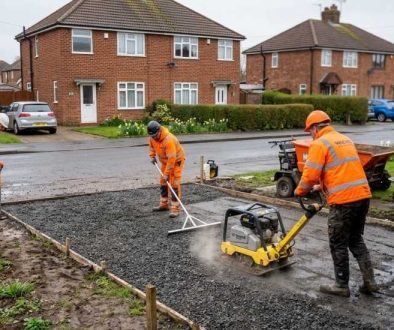
- Adequate excavation depth based on the expected load and soil condition
- High-quality sub-base materials that provide long-term stability
- Layered compaction, ensuring each level is properly consolidated
- Effective drainage design to move water away from the structure
- Strong edge restraints to maintain shape and alignment
Each of these elements works together. Removing or reducing any one of them increases the risk of failure.
At M&C Paving Northeast, these are not optional extras. They are the standard approach to every project.
Because a driveway is not judged by how it looks on installation day. It is judged by how it performs after years of use, through rain, cold, and constant pressure.
Taking shortcuts at the start almost always leads to repairs later.
When Repairs Are the Only Option
Once a driveway has started to sink, the issue cannot be resolved by surface adjustments alone.
Replacing a few blocks or levelling the top layer might improve the appearance temporarily, but it does not address the cause.
Proper repair focuses on rebuilding the structure.
This typically involves:
- Lifting the affected sections of the driveway
- Removing weakened or water-damaged sub-base material
- Rebuilding the foundation with the correct aggregate
- Compacting each layer thoroughly to restore stability
- Reinstalling the surface to proper levels and alignment
This process ensures that the problem is fixed at its source.
In many cases, early intervention can limit how much of the driveway needs to be repaired. Leaving the issue unchecked often leads to wider structural failure, which increases both cost and disruption.
Why Driveway Sinking Happens and What to Do Next
A sinking driveway is not random. It is the result of underlying structural issues that develop over time, often starting with poor groundwork or inadequate drainage.
Understanding the real cause of driveway sinking and prevention is what allows you to avoid repeated problems. Fixing the surface without addressing the base will only lead to the same issue returning.
If your driveway has started to dip, shift, or collect water, it is worth acting early while the problem is still contained.
At M&C Paving Northeast, every repair is approached with long-term performance in mind. That means identifying where the structure has failed, rebuilding it properly, and ensuring the same issue does not come back.
An early assessment can make the difference between a targeted repair and a full reconstruction. It also ensures your driveway remains safe, stable, and reliable through future seasons.
Contact us today and restore the strength of your driveway from the ground up.