Garden Wall Warning Signs to Check Before Winter
Garden walls get ignored until the day one falls over. They sit at the edge of the property doing quiet work, holding a boundary, retaining a bank, framing a driveway entrance, and nobody looks at them properly for years.
Autumn is when that neglect starts to cost money, because saturated brickwork and repeated frost do more damage in one winter than five summers combined.
Most garden wall repairs North East homeowners end up paying for could have been caught earlier by a ten-minute walk round the boundary with a set of keys in hand.
Why Autumn Is the Right Time to Look
Brickwork fails through water rather than age. Autumn is when the water arrives and the temperature starts dropping towards the point where it does harm.
- Sustained rain saturates brick and mortar that dried out over summer.
- Water sitting in open joints freezes, expands, and pushes the joint wider. The next cycle gets deeper.
- Storms put wind load on walls that are already weakened, particularly tall or slender ones.
- Repointing and rebuilding need settled, frost-free conditions, so leaving it until January limits your options.
Finding a problem in September usually means a repair. Finding the same problem in March often means a rebuild.
The 10-Minute Walk-Round
Take a walk along every wall on the property, front and back, and look at six things in order.
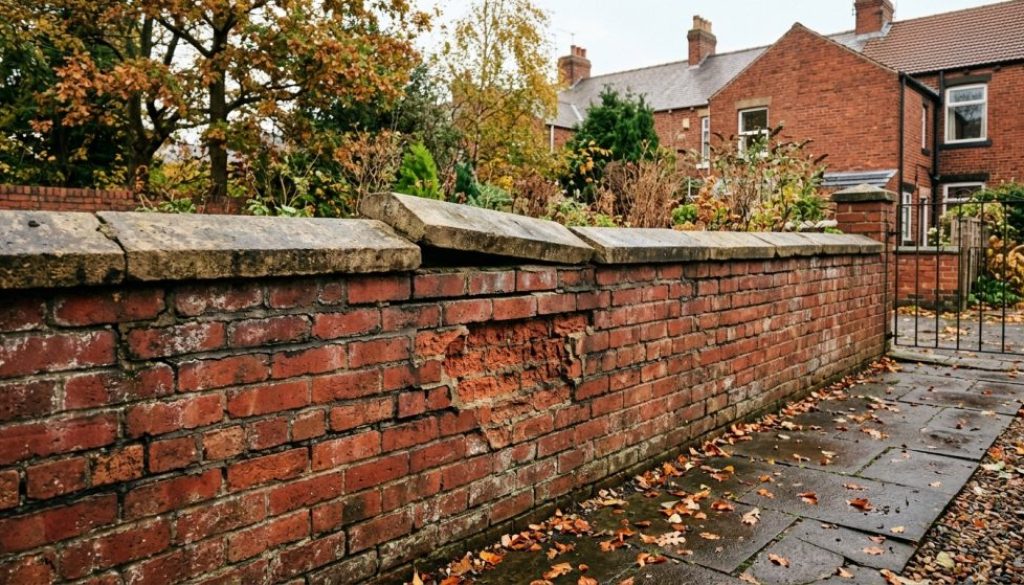
- Coping and the top course. Are any coping stones cracked, loose, missing or sitting at an angle? The top of a wall is its umbrella. Once it fails, water gets into the core.
- Mortar joints. Look for joints that have receded, gone crumbly or opened into visible gaps.
- Brick faces. Look for faces that have flaked, blistered or fallen away, exposing the softer material behind.
- Alignment. Stand at one end and sight along the wall. Bulges, bows and leans are far easier to see this way than face on.
- The base. Check where the wall meets the ground for cracking, movement, soil built up against the brickwork, or ground washed away from the foot.
- Cracking patterns. Note whether cracks run in stepped lines through the joints, straight through the bricks themselves, or horizontally along a single line.
Photograph anything you find. Comparing photographs in spring tells you whether a crack is stable or moving, which is the single most useful piece of information a contractor can be given.
Mortar Joints: The Detail That Decides Everything
Mortar is designed to be the sacrificial part of a wall. It takes the wear so the bricks do not, and it is meant to be replaced periodically. Judging its condition takes seconds.
The Key Test

Run a key or a penknife along a mortar joint. If the mortar crumbles or falls away under light pressure, it has failed and the wall needs repointing. Joints that have receded more than about 5mm behind the brick face are another clear signal. Sound mortar resists the key and stays put.
Repointing done properly lasts a long time. On a sheltered elevation it can hold for decades. On an exposed face taking driving rain and frost, the interval is considerably shorter, which matters on North East boundaries facing the coast or open ground.
Why the Wrong Mortar Makes Things Worse
This is where well-meant repairs cause damage. Older brickwork, broadly anything pre-1920, was built with lime mortar, which is soft and lets moisture escape through the joints. Repointing that with hard cement mortar traps the moisture and forces it out through the brick face instead. The result is spalled, crumbling brick, and it usually appears within a few winters.
The principle is simple: the mortar should always be softer than the brick. If your wall is old and someone has pointed it in strong grey cement, that is worth flagging when you get advice.
Spalling, Coping and Water Getting In
Once water reaches the inside of a wall, the damage accelerates.
- Spalling is the flaking or blowing of the brick face, caused by water freezing inside the brick. Exposed positions like garden walls need frost-resistant bricks, and older or reclaimed bricks are more vulnerable.
- Missing or loose copings let water straight into the top of the wall. Rebedding a coping stone is a small job. Rebuilding a saturated wall is not.
- Soil piled against brickwork keeps the base permanently damp and bridges any damp-proof course that exists.
- Vegetation growing out of joints widens them as it establishes. Ivy roots do genuine structural work over time.
- Horizontal cracking along a single line can indicate mortar expansion in a wall that stays wet, which usually needs proper assessment rather than a patch.
Leaning Walls and Driveway Piers
A wall that is out of plumb is telling you something about its foundation or its loading, and it will not correct itself.
Common causes include foundations that were never deep enough, tree roots lifting the base, ground pressure behind a wall that was never designed to retain anything, and vehicle contact.
Driveway entrance piers are the usual casualty of that last one. A pier takes a knock from a wing mirror or a reversing van, the mortar at the base cracks, water gets in, and the pier gradually goes out of true.
Treat a visible lean as urgent rather than cosmetic. A falling wall is a serious hazard, and where a wall is deemed dangerous the local authority has powers under the Building Act 1984 to require remedial work at the owner’s expense. Piers also carry gates, which multiplies the load every time the gate swings.
If the pier sits alongside your driveway, check the paving at its base too, since driveway edges and borders often move together with the brickwork they meet.

Retaining Walls Need Somewhere for Water to Go
Any wall holding back ground is doing a different job from a boundary wall, and it fails differently.
Water builds up behind retained ground and exerts pressure that most garden walls were never built to resist. A properly built retaining wall includes drainage behind it, usually a free-draining layer, a geotextile separation membrane and weep holes through the face.
If your retaining wall has no weep holes and the ground behind it stays sodden, that is a design issue rather than a maintenance one.
Where a wall retains more than a metre of ground, or supports anything above it, the design should be checked by a structural engineer. Bulging in the middle of a retaining wall is a warning worth acting on quickly.
Repair, Rebuild or Change Approach
Not every tired wall needs rebuilding, and not every wall is worth saving.
- Repointing alone suits a wall that is straight, stable and structurally sound, with failed joints as the only fault.
- Partial rebuild suits localised damage, a single failed pier, or a section that has moved while the rest is solid.
- Full rebuild becomes the sensible option once the wall leans, the foundation has failed, or spalling has spread across most of the brickwork.
- Replacing with fencing sometimes makes better sense, particularly for a long boundary where a rebuilt wall would cost far more than the job needs. Our earlier piece on checking boundaries before the weather turns covers what to look at.
The answer usually depends on the foundation, which is why a proper look on site beats guessing from photographs.
Rules Worth Knowing Before Rebuilding
Height limits catch people out, particularly at the front of a property.
- A wall next to a highway used by vehicles, including its footpath, is generally limited to 1 metre without planning permission.
- Elsewhere on the property, the usual limit is 2 metres.
- Anything added on top, such as trellis, counts towards the overall height.
- Conservation areas, listed buildings and Article 4 directions restrict these rights further, and taking a wall down can itself require permission in some circumstances.
Corner plots are the common trap, since a side boundary running along a pavement can fall under the lower limit as well as the front. A quick call to the local planning authority settles it before anyone orders bricks.
Getting a Garden Wall Ready for Winter
Walls give plenty of warning before they fail. Crumbling joints, spalled brick faces, a loose coping stone and a slight lean are all early-stage problems with straightforward fixes, and all of them get considerably more expensive after a wet winter and a run of frosts. The walk-round takes ten minutes and the photographs cost nothing.
If something on your boundary looks wrong, have it assessed while the weather still allows the work to be done. M&C Paving Northeast carries out brickwork and garden wall construction across Blyth, Newcastle and Northumberland, alongside driveway and kerb work and wider landscaping. Send us a photograph of what you have found, or get in touch to arrange a look before the first frost.
FAQs
For all your paving and landscaping services…
Call us today – 0191 743 2048