Turning a Front Garden Into Parking: What to Plan First
Swapping a front lawn for a parking space sounds simple. Lift the grass, lay some paving, park the car. A front garden driveway that works well and stays legal takes real planning before anyone lifts a spade.
Get the order right and you end up with easy access, no puddles, and a frontage that still looks like part of a home. Skip the planning and you can land a soggy slab, a rejected access application, or a bare grey rectangle.
Here is what to sort first.
Why a Front Garden Needs a Plan
A front garden does more than hold a car. It manages rainwater, frames your house, and connects to a public pavement you do not own, so the job touches rules and neighbours as well as materials.
That is why the smartest conversions start on paper. Access, drainage, surface, layout, and planting all pull on each other, and a change to one usually shifts the others.
Planning the whole thing as a single job, rather than a stack of separate decisions, is what stops a front garden driveway in the North East from turning into a run of expensive afterthoughts.
Start With the Dropped Kerb
Access is the first domino, because there is no point paving a parking space you cannot legally drive into. This is where many projects hit their first snag.
A dropped kerb is the lowered, sloping section of pavement that lets a vehicle cross safely from the road onto your drive. Driving over a standard kerb without one is against the rules, so this often decides whether the whole project can go ahead.
The work affects the public highway, which means it usually needs council approval, and each local authority runs its own process. Councils may weigh up driveway depth, road type, visibility, nearby junctions, parking pressure, trees, utility covers, and drainage before saying yes.
Because of all that, it pays to involve an experienced dropped kerb contractor early. A good one will visit, take measurements, check for buried services, and help manage the planning application rather than leaving you to navigate the paperwork alone.
The Drainage Rule You Cannot Ignore
Drainage is not just good practice on a front garden, it is written into planning law, and it catches homeowners out more than anything else. The rule is worth knowing before you choose a single slab.
Since October 2008 in England, paving over more than five square metres of front garden with an impermeable surface needs planning permission, unless the rainwater is directed to a lawn or border to drain away naturally.
Five square metres is roughly the footprint of a single parking space, so almost any full conversion has to deal with this. You avoid needing permission by choosing a permeable surface such as gravel, permeable block paving, or porous resin, or by channelling run-off into planting.
The reason is flooding, and the scale is easy to underestimate.
The Environment Agency once estimated that the equivalent of 22 Hyde Parks had been paved over across London alone between 1998 and 2008, sending rainwater rushing into drains instead of soaking into the ground.
Your front garden is a small piece of that puzzle, and handling its water properly keeps you legal and keeps the street drier.
Choosing Your Surface
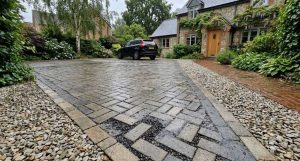
With access and drainage settled, the surface choice becomes a mix of looks, budget, and how the water needs to behave. Each option pulls its weight differently.
- Permeable block paving — decorative, repairable block by block, and drains through the joints
- Resin-bound — smooth, modern, and porous, sitting at the premium end
- Gravel — cheap and naturally permeable, though it scatters and needs topping up
- Tarmac or standard concrete — hard-wearing and good value, but impermeable, so run-off must be planned for
If you want the tidy, high-end look, block paving or resin usually deliver it while keeping you on the right side of the drainage rule. A solid installer will match the surface to your soil, slope, and budget rather than steering you at the dearest option.
Layout, Access And Everyday Use
A parking space has to work every single day, so the layout deserves as much thought as the surface. Picture the car in place and walk through the awkward moments before they are set in stone.
- Space to turn and open doors — can you get in and out without clipping the wall or the neighbour’s fence?
- A clear path to the front door — keep a dry, safe route for people and shopping
- Bin and bike access — leave room to wheel things past a parked car
- Edging and containment — firm edges stop gravel wandering and keep paving tight
- Room for a second vehicle — plan now if a van or a second car is likely later
Getting these right early is the difference between a drive that feels generous and one where every arrival is a three-point manoeuvre.
Keep Some Green: Borders and Planting
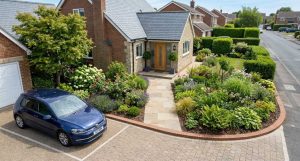
A common regret is trading a garden for a car park and losing all the charm in the process. You do not have to. A little planning keeps the frontage looking like a home.
Retaining a planted border or a strip of lawn does two jobs at once. It softens the look so the frontage does not read as a bare slab, and it gives rainwater somewhere to drain, which helps with the planning rule at the same time. Borders, low hedging, and neat edges are exactly the sort of finishing touches a full landscaping service can fold into the same job, so the parking and the greenery arrive together rather than as a rushed patch-up later.
Book Your Front Garden Driveway With M&C
M&C Paving Northeast plan front garden conversions as one joined-up job across Blyth, Newcastle upon Tyne, Northumberland, and the wider North East. That means dropped kerb access, driveway surfacing, drainage, edging, and planting handled by a single in-house team with more than 25 years behind them, plus help with the council paperwork where it is needed.
Turning a front garden into parking is one of the most useful upgrades a home can make, and July is a sensible month to get the planning moving before the busy season fills up. Sort the access, the drainage, and the layout first, and the paving becomes the easy part.
See options on our driveway contractors page or request a free quote through our contact page. Speak to a local team this summer.
FAQs
For all your paving and landscaping services…
Call us today – 0191 743 2048