How Poor Drainage Damages Any Paved Surface
Water is rarely the first thing homeowners think about when a driveway or patio starts showing signs of wear. Cracks appear, edges begin to lift, and surfaces start to sink; the assumption is often that the materials have simply aged. In many cases, however, the real cause is far more preventable.
Poor drainage paved surface problems are one of the most common reasons driveways and patios fail earlier than expected. When water cannot drain away properly, it slowly weakens the base beneath the paving. The damage develops gradually, often hidden below the surface, until visible signs such as cracking, movement, or sinking begin to appear.
Understanding how drainage affects the longevity of your paving is the first step in protecting what is, for most homeowners, a significant investment.
Why Water Is the Enemy of Paved Surfaces
Most people understand that standing water is not ideal, but fewer appreciate just how much damage water can cause when it has nowhere to go. When rainfall lands on a paved surface and cannot drain away efficiently, it begins to find its own path — and that path often leads directly into the sub-base beneath.
The sub-base is the foundational layer that gives any driveway, patio, or path its structural integrity. It is typically made up of compacted aggregate, and whilst it is designed to bear load, it is not designed to be repeatedly saturated. Once water penetrates and begins to soften the sub-base, the surface above loses its support. Over time, this leads to uneven settling, which shows up as dips, humps, and cracked slabs or tarmac.
In the North East of England, this process is accelerated by the freeze-thaw cycle that comes with colder months. Water that has soaked into the sub-base expands when it freezes, forcing materials apart, and then contracts again when it thaws — leaving gaps, voids, and weakened areas that worsen with every cold spell.
The Most Common Drainage Problems Found on Driveways and Patios
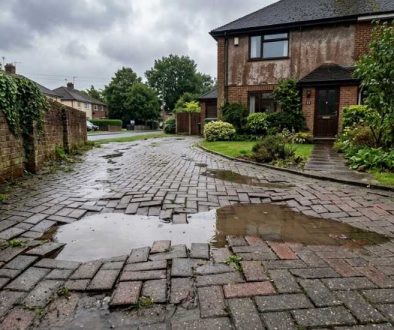
Not all drainage problems look the same, but they tend to share the same root cause — water that has not been managed properly from the outset. Surface pooling is the most obvious sign. If water sits on your driveway or patio after rainfall rather than dispersing within a reasonable time, the surface gradient is likely insufficient or the drainage points are blocked or absent altogether.
Beyond pooling, there are less visible problems that are equally damaging:
- Inadequate surface falls — Paving should be laid with a deliberate slope to direct water away from buildings and towards drainage points. Without this, water gravitates towards the lowest point, which is often the edge of the surface or the base of a wall.
- Blocked or absent channel drains — Channel drains intercept water before it can cause harm, but they require regular maintenance. A blocked drain offers little protection.
- Poorly positioned downpipes — Rainwater from guttering that discharges directly onto a paved surface without a drainage connection compounds the volume of water the surface has to manage.
- Impermeable surfaces with no run-off route — Solid surfaces that cover large areas without a clear outlet for water leave it with nowhere to go but down, straight into the sub-base.
Each of these issues, left unaddressed, contributes to the breakdown of a poor drainage paved surface over months and years.
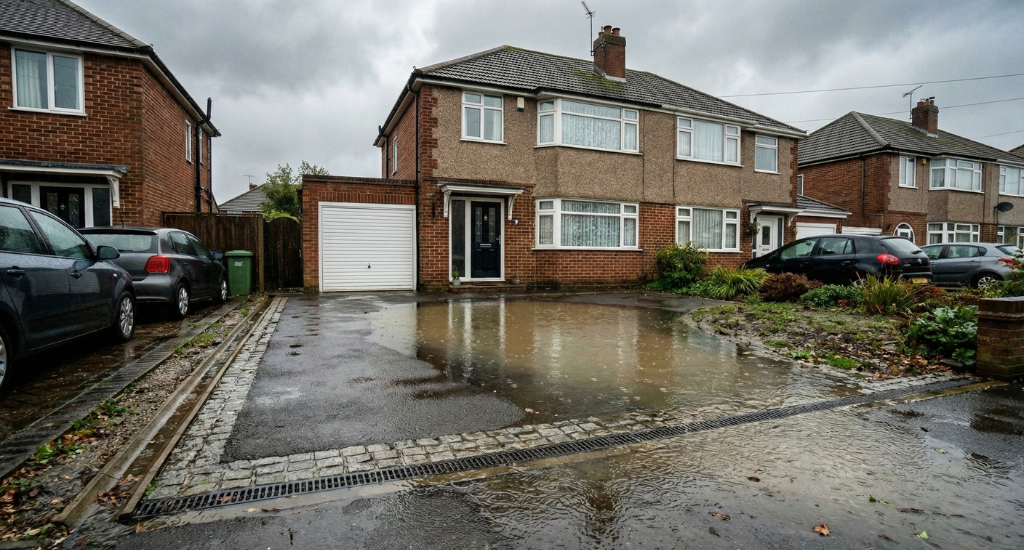
How Poor Drainage Causes Specific Types of Damage
Once water is consistently getting beneath a paved surface, a predictable pattern of damage follows. The specific type of damage depends on the surface material, the severity of the drainage issue, and how long it has been present — but the outcomes are broadly consistent.
Cracking is usually the first visible sign. As the sub-base shifts under the weight of traffic and the effects of saturation, the surface above flexes and eventually fractures. On block paving, individual blocks begin to rock and sink.
On tarmac, surface cracking spreads in a pattern often described as alligatoring. On natural stone or concrete slabs, joints open up and slabs begin to tip.
Subsidence follows if the problem is not addressed. As voids form beneath the surface, whole sections can drop, creating uneven areas that become both a trip hazard and an accelerating point of further water ingress.
Edge failure is also common — the perimeter of a paved area is typically its most vulnerable point, and without adequate drainage, edges lift, crumble, or separate from the main body of the surface.
The cost of repairing damage at this stage is considerably higher than the cost of addressing the drainage problem at the outset, which is why professional assessment before any paving work is always advisable.
What Good Drainage Actually Looks Like
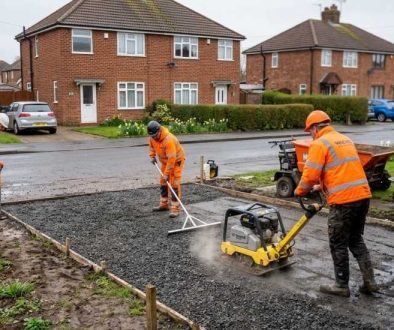
Effective drainage does not happen by accident. It is the result of deliberate planning and correct installation from the ground up. A well-drained surface begins with the right sub-base preparation — adequate depth, appropriate materials, and proper compaction to ensure stability even under wet conditions.
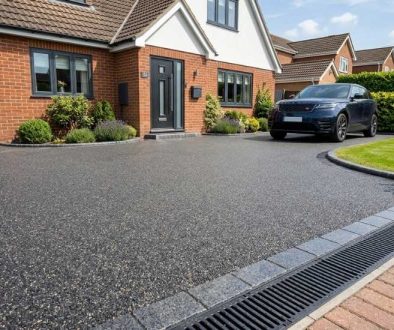
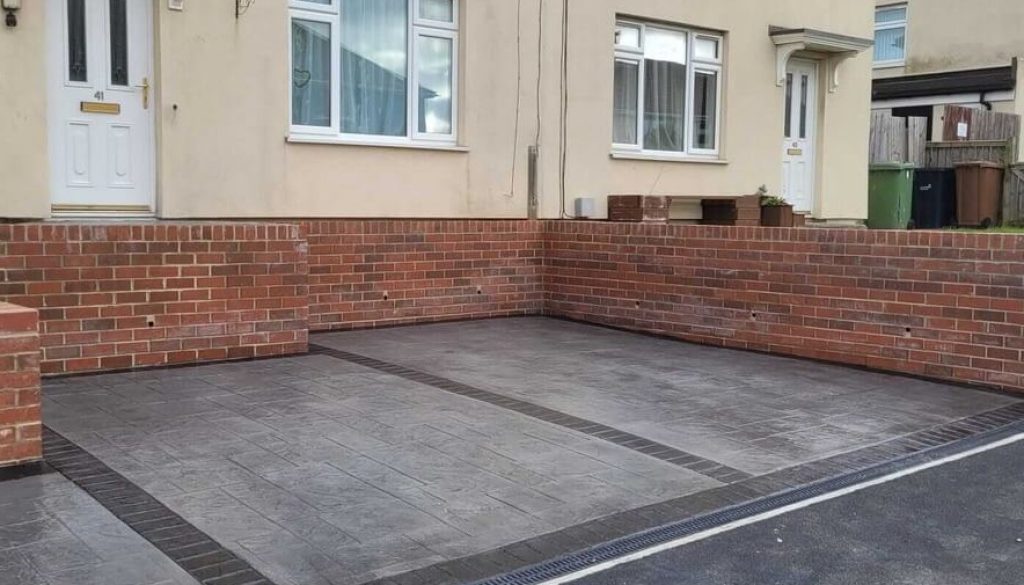
Surface gradients are equally important. A correctly laid driveway or patio will have a fall of at least 1:60 away from any building, directing water towards a suitable outlet. Channel drains, linear drains, or gully points should be positioned at the lowest points of the surface to intercept water before it can cause harm.
For larger areas, or in locations where ground conditions make conventional drainage difficult, permeable paving offers a practical alternative — allowing water to pass through the surface itself and be managed at sub-base level.
Expert installation ensures that whichever drainage solution is used, it is sized, positioned, and built correctly for the specific site conditions.
If drainage problems keep returning, replacing the surface with professionally installed Newcastle Patios can ensure the correct base preparation, slope, and water management are built into the design from the start.
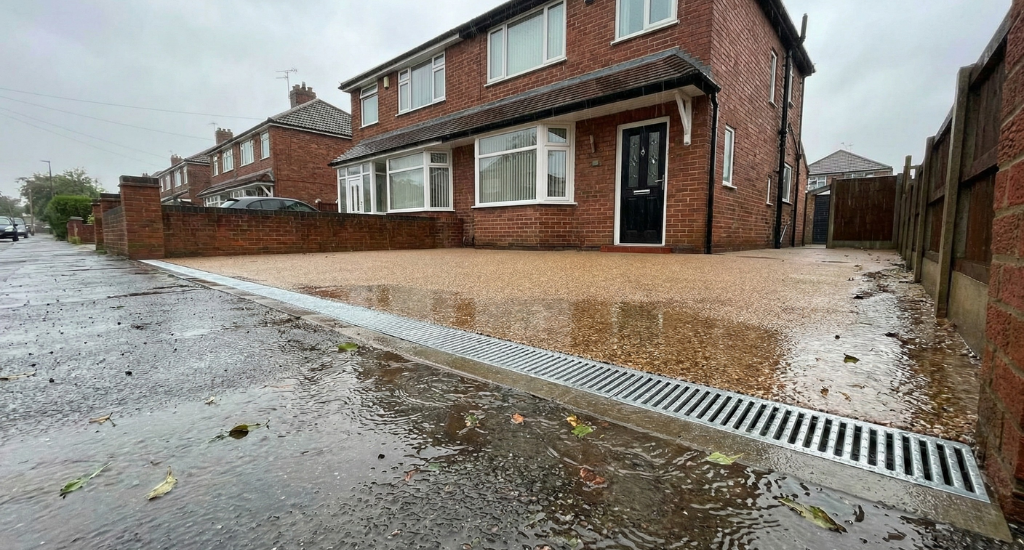
Poor Drainage Paved Surface Problems: Why Getting Drainage Right Matters
A poor drainage paved surface does not fail all at once — it deteriorates steadily, often in ways that are easy to dismiss until the damage becomes impossible to ignore.
By the time cracks are spreading, edges are lifting, and sections are sinking, the cost of putting things right is considerably greater than it would have been to address drainage correctly at the point of installation.
For homeowners in the North East, where rainfall is consistent and winters bring repeated freeze-thaw cycles, drainage is not a minor detail — it is one of the most important factors in determining how long a paved surface will last.
Whether you are planning a new driveway, replacing an existing one, or beginning to notice the early signs of deterioration, getting a professional assessment of your drainage situation is always the right starting point.
M&C Paving Northeast brings the expertise and local knowledge to ensure that every surface is built — or restored — with drainage that works. From sub-base preparation to surface falls and drain installation, every element is handled to a standard that protects your investment for the long term. To discuss your project or arrange an assessment, contact M&C Paving Northeast today.